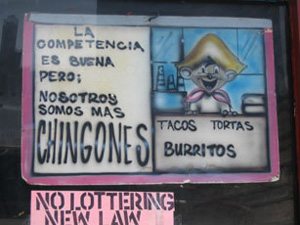
Chin …


El Gallo de Oro Mexican Restaurant

Actually, that’s only the half of it. When I was in Celaya, Sometimes my cousin Ignacio caught himself in mid-word, “¡Chin … !“, when he saw children around, and not complete the final syllables of “-gado.” My father would start out, “Chi …” and then see my brothers and me, and immediately change to the word, “¡Chihuahua!” You see Mexicans are famous for being the most notorious practitioners of swearing of all Spanish speakers in the world. And their favorite swear word has to be, “chingado.” Occasionally, when my father didn’t feel like referring to dogs or cheese with the word “chihuahua” would say, “chispas,” which merely means sparks. So if you hear someone who is frustrated by their present circumstances, and they shout, “¡Chispas!“, “¡Chihuahua!“, or “¡Chingado!“, behold (and beware), because you are most certainly in the presence of a Mexican.
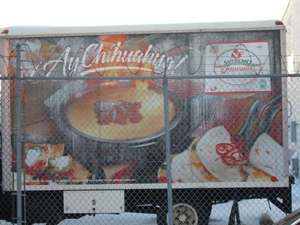
¡Ay Chihuahua! is a common Mexican expression.

The other day, my Spanish class asked me about the word “chingado” and I was brutally honest with them. I told them that it’s derived from an Aztec word. Since I had the interest of the entire class, I snuck in a Spanish class without them realizing it. I began with the infinitive chingar and I conjugated it for them: chingo, chingas, chinga, chingamos, chingáis, chingan. They were so enthralled by me lesson that they didn’t even complain that I had used the vosotros form of the verb, as they usually are scared of it. I even showed them how to use the past participle as an adjective: chingado gobierno, chingada migra, chingados rateros, chingadas cuentas. Once I had their interest, I was able to teach that day’s lesson easily. They paid attention the whole class. It was simply amazing!

DDR

Jenny


High school Spanish student.

Now that I think of it, I have also had some memorable Spanish teachers in addition to Enrico Mordini at Divine Heart Seminary. My first semester at UIC, I made sure that I registered for a Spanish class. I took a placement test on which I scored poorly. When you sort of know Spanish, as I did then, you manage to talk yourself into the wrong answer many times just because it sounds right. I had to take a second placement test in the Spanish department because I had a Spanish surname, I admitted that I came from a Spanish-speaking family, and I still actually spoke Spanish. Sort of. For the placement test, I had to write in Spanish and explain where I worked and what I planned to do at UIC. This was actually exceedingly difficult for me because I only studied Spanish for two years at Divine Heart Seminary and I didn’t really apply myself because I was just a rebellious teenager. I occasionally wrote letters in Spanish to Mexico, but they were usually truly short. So, I wrote this little essay in Spanish, and they placed me in Spanish class for heritage speakers. This class consisted of students from Spanish-speaking backgrounds who sort of knew Spanish, but not really.

I will always remember our first Spanish instructor. She was a teaching assistant from the Dominican Republic named Juana. She insisted that we call her Jenny. I think she wanted to fit in with the rest of the Americans. As a side note, I was always, and still am, amazed by the fact that graduate students would come from Spanish-speaking countries to UIC to study Spanish. Anyway, Jenny was quite a teacher. When we took exams, she would look it over and tell us we might want to look over a certain answer. When I did, I realized that I was wrong, and she gave me a chance to correct my mistakes. She came to Chicago in September, and she was amazed at how cold it was: about 60 degrees Fahrenheit! The next week, the temperature dropped to about 50 degrees. When I saw her walking to class that 50-degree day, she wore a full-length winter coat, a hat, a scarf, and gloves. She couldn’t believe how cold it was in Chicago. Just as a warning, I told her that it would get much colder in just a few weeks. I also reminded her that it also snowed in Chicago. Once winter arrived, she would only take off her hat, scarf, and gloves, but keep her coat on. She would shiver during the whole class. When she graduated with her master’s degree, she immediately went back to the Dominican Republic.

Choosing a major


University Hall, University of Illinois at Chicago

When I was an undergrad, I couldn’t decide on a major. After much deliberation, I finally narrowed it down to English or Spanish. After even more deliberation, I decided not to decide and I double-majored in English and Spanish. My emphasis in both majors was literature.

I love to read. And besides, my personal agenda includes writing The Great American Novel, that is, if I ever actually got around to sitting down at my computer and writing a novel. Nothing would help me achieve my goal more easily than majoring in Spanish, and oh, yes, English, too.

Anyway, by doing this double major, I straddled two academic cultures. I saw the best and worst of both worlds. Most of the students who majored in Spanish were from the middle or lower class and were very humble. The students who majored in English were also from the middle or lower class, but they thought they were really cool. Not every English major exuded this arrogant aura of “cool.” Just a handful, but just enough to annoy the rest of the class. Whenever they said something they thought was extremely brilliant or witty, they would proudly announce, “I’m an English major!” as if no one else in the classroom was also an English major.

Some of the English professors were of the plain vanilla variety who seemed tired of Academia, the “cool” English majors, and the literature they taught. The Spanish professors, on the other hand, were from Spanish-speaking countries who also seemed tired of Academia, but lacked “cool” students, and absolutely loved their subject. In general, there was much more laughter in my Spanish classes than in my English classes. The Spanish professors weren’t afraid to reveal their cynicism and world-weariness in satirical and humorous ways, and besides, the literature in Spanish is generally much funnier than literature in English.

Of course, whatever literary theory I learned in English classes, I applied to my Spanish classes, thereby making me one of the better Spanish students. I have never regretted my decision to major in both English and Spanish. Eventually, I will write a novel, even if it doesn’t achieve The Great American Novel status. But I did learn a lot about world literature as a double major in Spanish and English. I feel so “cool” since I majored in English!

DDR

Translations


A Spanish student’s best friend!

Translation from one language to another always poses a problem. Dictionaries alone aren’t enough. They never have the latest technological terms. New products aren’t in there, either. For new products, I looked at the sales inserts of our local Spanish papers and most of the time I found the term I needed.

Now, with the Internet, there are all kinds of translators available. Sometimes students use them for their Spanish compositions. They write the composition in English first and then have the translator translate it for them. I can always tell when they use the translator because the composition looks as if it’s written in Spanish. However, the text is unintelligible. Yes, every word is in Spanish, but the wrong words were chosen, and the syntax is all wrong. The students write a better composition if they write entirely in Spanish. Even when they make mistakes, I can still decipher their intended meaning.

Occasionally, when I need to translate a word that’s not in one of my many dictionaries, I go to the internet and use an online translator for a word or two. Not all the translations are satisfactory. I’ve discovered that Wikipedia.com makes a great translator. A student needed to translate “jigsaw puzzle” into Spanish, and none of my dictionaries had it. So, I looked up jigsaw puzzle on Wikipedia and then I chose to read the article in Spanish got rompecabezas. For years, I’ve meaning to translate Daylight Saving Time into Spanish unsuccessfully. Today I looked it up on Wikipedia and got el horario de verano. This method would work for many languages because most of the Wikipedia articles are translated into many languages.

DDR

Written Spanish


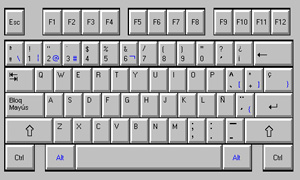
Spanish keyboard map.

I’ve already mentioned how when I went to Mexico everyone seemed to comment on my American accent when I spoke Spanish. Well, my written Spanish is much better than many of my Mexican relatives. I often get letters from Mexico and some relatives just don’t use accent marks that are necessary when writing in Spanish. When I e-mail my cousin in Mexico, she is always amazed that I write much better in Spanish than her, even though she’s a native speaker. Another cousin constantly IMs me. Every so often, she asks me how her Spanish is. I tell her it’s surprisingly good, even though she doesn’t spell very well, doesn’t capitalize at the beginning of sentences, and doesn’t use any punctuation. Some of my Spanish students have seen these types of writings in Spanish and then question why I insist that they use accent marks and ñ and all things Spanish. Well, the main reason is to show that you have been educated. It works for me because my cousins take more seriously when I write proper Spanish.

DDR