“Hablar” is “to talk” or “to speak” in the general sense of emitting intelligible sounds from the aperture of the human brain housing group. “Charlar” is “to chat” or “to talk to someone.” “Platicar” is also a synonym of “charlar.”
“El idioma” refers to the language which we use to communicate. For example, “yo te expliqué la diferencia entre “charlar” y “hablar” en inglés. Pero, cuando dije “in the general sense of emitting intelligible sounds from the aperture of the human brain housing group”, un lenguaje particular porque podría haber dicho lo mismo con otras palabras. O, sea, el lenguaje es la selección del vocabulario. No importa si fuera en inglés o español.
I’m back in school now and my teaching skills are rusty. I must get back into practice. Sometimes the class doesn’t want to pay attention to me for some unknown reason. If they merely not paid attention and didn’t talk, I would be okay with that. However, sometimes they continue talking when I’m trying to talk. This occasionally happens to the best of teachers. Yes, even me! But I know how to regain control of the class.
I have many tricks in my repertoire to silence the class. Sometimes I say, “¡Atención!” and that’s enough to quiet the class. Sometimes, I have to raise my voice and say, “¡Silencio!” Surprisingly, sometimes the class continues talking. So, I threaten to write the names of the students talking on the blackboard. My sons told me that some grade school teachers use this threat effectively. I wasn’t sure whether or not it would work at the university level, but I did try it once and the entire class immediately stopped talking. I was like totally amazed. If that doesn’t work, I yell, “¡Cállate!”
However, I’ll tell you my absolute favorite tactic. Raising my voice and saying, “Don’t make me snap my fingers in a z-formation.” I then snap my fingers in a z-formation. (Please note: You must say, “Don’t make me snap my fingers in a z-formation” in English.) Amazingly, the entire class stops talking instantly.
Once in a blue moon, none of the above strategies work. So what do I do? I very quietly say, “Shh.” That has never failed me! Yet.
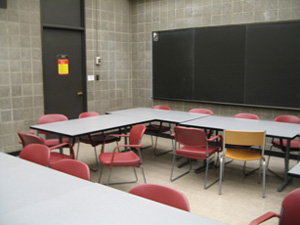
My Spanish class met for the last time this morning. Some students will never study Spanish again, but hopefully, they’ll remember more than just, “Buenos días” and “¿Cómo está usted?” The students take the last exam and they slowly leave the classroom one by one. The classroom is now empty. It’s very quiet for the first time in the semester. I’m all by myself and I already miss my students. They sometimes annoy me during the semester, but then I miss them when they’re gone. Go figure! I’ll just have to wait untill next semester to see my new students.
World History with Mr. Gibson, Divine Heart Seminary, Donaldson, Indiana
I’m still undecided on whether or not I like teaching. On good days, teaching doesn’t even feel like a chore and I truly enjoy interacting with the students. On bad days, I look at the bright side of things: At least no one shot at me! But I shouldn’t get so dramatic. But that’s one of the reasons I never wanted to teach in the Chicago Public Schools.
I chose to teach college and university students because I would rather deal with adults. All the students are at least eighteen years old. University students have the responsibility to study and do their homework. If they fail the course, it’s their fault for not having studied enough and doing all the required homework.
Actually, I like interacting with the students. We really have fun discussing a wide variety of topics, probably because they’re nowhere to be found on the syllabus. I do go off on a tangent sometimes in the classroom, but then I remember to somehow incorporate something from the Spanish lesson into conversation. And even though I stray from the lesson from time to time, I still manage to teach everything that’s listed on the syllabus in a way that keeps the students entertained while they learn Spanish.
What I do hate about teaching is all the bureaucracy. I hate doing all the paperwork involved. It’s bad enough I have a lot of homework to correct, but then I have to record all the grades and answer to my bureaucratic superiors.
Some Spanish students just amaze me with some of the things they tell me, particularly when it comes to criticism about teaching. Some students are very blunt and opinionated when criticizing teachers. Most often, they don’t tell me what they think about me or my style of teaching, but they will tell me how they changed to my class because they couldn’t understand the other instructor because he or she spoke Spanish too quickly. Sometimes students will tell me that my Spanish class is their favorite class, which makes me a bit uncomfortable. Then, some will even add that my Spanish class has been the best class of their entire college education.
I can honestly say that most of my students are happy to come to class and we often have fun together and laugh a lot during class. However, I don’t feel that I deserve all the compliments that I receive. When I used to teach at Morton College, an instructor who taught in the classroom next to mine commented about all the laughter she heard emanating from my classroom. “You must teach a fun class,” she said. “What do you teach?” “Spanish,” I said. She gave me this look of disbelief. Normally, most students dread studying a foreign language and only do so to fulfill the mandatory general education requirements. But most of my students love coming to class! This last semester, many students told me that this was the most Spanish they had ever learned. And they had fun in class.
When I first started teaching Spanish at UIC, I wasn’t sure what to expect of the students. Overall, they were certainly a notch above community college students because of stricter admissions standards. The main difference was in the attitude toward me as a Spanish teacher by the two school administrations. At the community colleges where I had taught, I was in charge. They would give me a textbook and tell me that I had to cover a certain number of chapters, which I always did. But I had a lot of freedom in the classroom. Then, I started teaching at UIC, which is a research university, where most of the 100-level Spanish classes were taught by teaching assistants. Since there are hundreds of 100-level classes and the possibility of cheating increases exponentially, the classes are more controlled and there is less freedom for the instructor in the classroom. Plus, the administration wanted all the classes to be equally fair to all the students. So, it took me a while to adjust.
I’ve always liked showing movies in Spanish class. At UIC, I once asked if it would be okay to show a movie if we had time and I was told no. So, I didn’t show a movie. I recalled how students liked watching a movie, in Spanish, set in a Spanish-speaking country. I always picked a movie that demonstrated some cultural aspects of Spanish or Latin American society. Anyway, I decided that I would show a movie to my classes the next semester. How did I get around getting permission? Simple! I just didn’t ask for permission to show the movie. If I had asked, I would have been told no. And then I wouldn’t be able to show a movie because I was ordered not to. So, I just showed it. If anyone of my superiors would have told me anything, I would have said, “But no one told me that I couldn’t show a movie.” Of course, none of my students ever mentioned watching movies in Spanish class.
So, one day at UIC, one of my students tells me that I’m a very good Spanish teacher. I said, “Muchas gracias” and left it at that because I don’t take compliments very well. She was a good student who always paid attention in class and always did the homework and participated in class. Another day, she told me that her friend was also in the same Spanish 103 class as her, but in a different section. Her friend wasn’t happy with her Spanish instructor. A couple of weeks later, she told me how her friend had transferred to UIC from Daley College and how her Spanish instructor at Daley College was so much better than the one she presently had at UIC. She just went on and on about how her friend had learned so much Spanish at Daley College and how her instructor was so enthusiastic and always answered all her questions. I must admit that I got very bit uncomfortable by all this talk. I wondered who this super Spanish instructor was. I was also afraid that my students would be disappointed to have to settle for me as their Spanish teacher instead of having that teaching wonder from Daley College. One day, I’m leaving Lincoln Hall where I teach Spanish 103. The student who always talked about her friend at Daley College is exiting alongside me. Well, who do see on our way out? Her friend. “Carol!” my student shouts at her. Carol and I looked at each other and we immediately recognized each other. I used to teach at Daley College and Carol was my student back then. The Spanish instructor she was talking about was me!





 Chicago USA