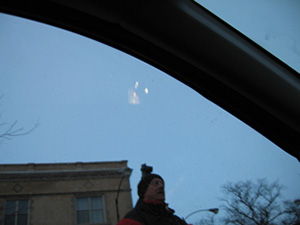
Sometimes when I drive to school in the morning, I buy the newspaper from one of those guys standing in the middle of the street. Most of the time the vendor is African-American. In fact, I can’t think of one who wasn’t African-American. So this morning, I noticed that the vendor on the corner of Ashland Avenue and Garfield Boulevard was not African-American. After some thought, I realized that he had been there for a few weeks now, but I just now realized it. And, I still haven’t bought a newspaper from him.
Was I discriminating against him because of the color of his skin? Did I discriminate against him consciously? Years ago, I had a newspaper vendor, African-American, of course, from whom I regularly bought the newspaper. If the light turned red, he would chat with me until the light turned green. I’m sure that amounted to less newspaper sales, but he seemed to enjoy talking to me. At Christmas, I would give him a Christmas card with a crisp twenty-dollar bill inside. I did for two years, but then he mysteriously disappeared from the corner of Damen Avenue and Garfield Boulevard. I never saw him again.
The other day, I had the strongest urge to visit Barack Obama’s house. I don’t know what came over me, but suddenly I had this great desire to visit a famous place in the news. I told my sons, “We’re going to President Elect Barack Obama’s house!” At first, I thought they would they would look at me as if I were crazy, which is their normal reaction when I suggest any new and exciting activity. I was wrong! They actually thought it was a great idea. Only that they somehow imagined that his house was very, very far away. I explained that he lived less than thirty minutes from us.
So off we went in search of Barack Obama’s house in Hyde Park. I knew the security would be tight because I watched the news and I saw the concrete barriers around his house. There were many, many Chicago police officers around his house–a two-block radius around his house. I told my sons before we even set out on our trip that we might not even get close to the Obama house, but we could at least visit the neighborhood of the President of the United States of America.
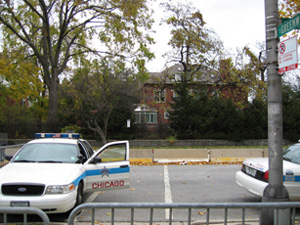
Surprisingly, I was able to park legally at the corner right near a police car that was guarding the closed off intersection leading to his house. As we approached the corner, the police officer exited her squad car and asked if we lived on this side of the block. I said no and she said we would have to walk across the street. Before I left our house, I had no idea where Obama lived other than in Hyde Park, but I figured I’d find his house once I saw all the police cars blocking off the streets. I really thought we would have to walk several blocks. But we were extremely lucky to park so close!
There were multiple police cars and police officers standing out in the middle of the barricaded street. I saw a group of gawkers taking pictures of a house, so I asked, “Is that his house?” and they responded in awe, “That’s his house!” Lo and behold! We had arrived at Barack Obama’s house. As seen on TV! My sons couldn’t believe I had taken them all the way to the front of Barack Obama’s house, albeit across the street. I took some pictures and then we walked away. The police officer who directed us across the street smiled at us and asked if we enjoyed our visit. We said we did and walked back to our car.
As we were getting into the car, I realized that this was exactly the kind of trip my father used to take us on when we were little. He would see something on the news and then take us there. He wouldn’t tell us where we were going. It was just like, “¡Vámonos!” and we would all pile into the car and go. Once, my father saw a chess master playing 25 boards simultaneously at a restaurant in Little Italy, so off we went to play the chess master! The next day, my friends at school told me they saw me playing chess on the news!
When the plane crashed before reaching Midway Airport in 1971, my father took us to the crash site despite the fact that on the news they told everyone to stay away. We were less that a quarter-block away and we could see the actual fuselage and tail of the plane that crashed! However, no one saw us on the news that time.
Many people saw my father on the news many times over the years. He just loved the limelight. On the IRS tax deadline day one year, I was watching the news and they showed all the last-minute filers going to the downtown post office to get that coveted April 16th postmark in order to beat the IRS deadline. They interviewed several last-minute filers and all the while I thought, “What idiots! Waiting till the last minute to file their tax returns!” Suddenly, I saw a familiar face. It was my father! He was being interviewed by the news reporter. Somehow he always found a way to get on the news!
I guess by taking my sons to Obama’s house, I was keeping my father’s tradition alive. I didn’t get on the news during our visit to his house, but I realized that I did inherit my father’s thirst to go to where the news is. Ugh! I’ve become my father! ¡Ay! ¡Ay! ¡Ay!
I’ve been going to the Chicago Public Library since I was six. I’m not sure why, but I always loved being surrounded by all those books. For a while there back in grade school, I used to hang out at the library with my best friend Patrick. We would sit there reading joke books and asking each other riddles. We had a lot of fun while trying not to laugh too loudly.
Then, something terrible happened to the libraries. There was an enormous change of attitude toward the patrons by the librarians. None seemed too interested in helping us, the readers, in the 1970s. That was about the time that I started buying books instead of borrowing them from the library. I loved owning my own books. Of course, that was a time when I actually had time to go back to my books to reread them.
In the 1980s, the library began to computerize its tracking system. The computers were always down and they had to resort to the old paper system whenever I checked out a book. Then, lo and behold, some reporter discovered that the City of Chicago awarded the computer contract through patronage. That’s the Chicago Way! And no one was really shocked. I hated going to the library because the librarians stared daggers at you if you asked for help to find a book or if you wanted to check it out. And just forget about even trying to get a book delivered from another branch. I just stopped going to the library.
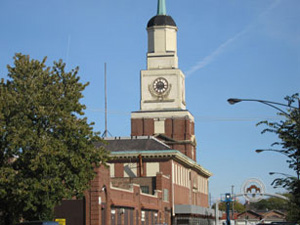
The last few years, however, our library system has been thoroughly modernized. I think it started improving when Bill Gates donated Microsoft software to the library. Lately, I’ve been patronizing the library regularly. When I got divorced and sold our house, I had to move to a smaller house. So, I had to get rid of two-thirds of the books that I had accumulated over the years. Now, I borrow books instead of buying them. And this is where the library comes in. The library in the picture above is within walking distance of my house. I don’t even have to go to the library to order the books. The computer system works perfectly now. I look up whatever book I want and if the library system owns it, I can get it delivered to my library where they will hold it for a week. I’m just amazed by how efficiently the library works now!
So, after I read The Jungle by Upton Sinclair, I read some of the ancillary material at the end of the Norton Critical Edition that added to my understanding of the novel. I read an interesting statement from Wages and Family Budgets in the Chicago Stockyards District: “The Lithuanians, Poles, and Slovaks will work for wages which would seem small to the average American workingman. The standards of living of these workers are comparatively low and over half of them are boarders without families to support, so they can easily underbid Americans, Germans, and Bohemians.” In the novel, we see Jurgis and many other Lithuanians working for low wages that take away jobs from Americans. And they live in deplorable conditions. Well, this accurately describes today’s immigrants, regardless of their origin.
I also read a very interesting book that researched the places described in The Jungle: Upton Sinclair: The Lithuanian Jungle by Giedrius Subacius, whom I met since he is a professor at the University of Illinois at Chicago. This book simply enthralled me because I remembered the areas Subacius describes. When I met him, I had not yet read his book. He described how he went and spoke to people from Back of the Yards. The book has recent pictures of the neighborhood and some from the archives for places that no longer exist. After speaking to him, I tried checking out the book from the UIC Richard J. Daley Library, but it was constantly checked out. I finally checked it out over the summer when no one was using it for class. This book is a must-read for any Chicago history buff.
I just finished rereading The Jungle by Upton Sinclair. This is a book I knew about since about the third grade because the Lithuanian nuns also mentioned it at Holy Cross School. The nuns always wanted to remind us that we didn’t always have life so easy. They would often describe the squalid living conditions of our neighborhood, The Back of the Yards, and the horrendous working conditions at the Union International Stock Yards. They stressed that education was the best way to improve our lives and that we should excel in grade school, to get into a good Catholic school, to prepare us for college. I always recall the incident about the boy who drowns in the street. Several nuns over the years described that scene. And we were so lucky to live in a neighborhood with concrete sidewalks, paved streets, and a sewage system. No one from our neighborhood ever drowned in the street–that I know of.
When I worked at Derby Foods, we didn’t have a union even though Chicago has always been known as a union town. And I didn’t realize it at the time, but we didn’t need a union because all the other factories around us were unionized. Our factory paid us above-average wages and we worked under better-than-normal working conditions. They followed bidding by seniority for different job openings in the factory.
Regardless, I hated working there because I was a lowly manual laborer. The money was good, but I was unhappy about not being able to go to college. I continued working there because … because–just because. When I started at Derby Foods, about three-hundred people worked there. But over the years, the company kept modernizing by buying machinery that would replace employees. By the time I had eight years on the job, I was still near the bottom of the seniority list of about 134 employees due to the lack of hiring because of the worker displacement caused by the new machinery. Since I was at the bottom of the list, I had to work an undesirable work schedule. In food production, the plant and machinery must be cleaned and sanitized on a regular basis. Well, I had to work the third shift from 11:00 pm until 7:00 am. Regardless of what anyone says, the human body never fully adapts to a nocturnal life. The schedule was bearable until Saturday when I would get off at 7:00 am but I would have to return at noon to clean and sanitize the plant at 11:00 am. Everyone else who worked the Saturday shift worked either days or afternoons, so they didn’t complain. Besides, they enjoyed working for time and a half because it was a Saturday.
I complained about my schedule to my foreman, the shift foreman, and the manager. No one thought it was a problem. I had no union with whom to file a grievance, so I called the federal labor law organization, and they told me that my employer was not violating any federal laws by requiring me to return to work an eight-hour shift within four hours of working an eight-hour shift. Well, I was happy that I tried everything possible to improve my working conditions.
Then, it dawned on me! I’ll read The Jungle! I’ll find scenes in the novel that compare to my present working conditions! So, during my breaks and down time in factory, I read the paperback edition of The Jungle that I always carried in my back pocket. When I was done, I was so grateful to be working for Derby Foods! I never realized how good I had it compared to the Stockyard workers in the early 1900s. Because of that book, federal laws were enacted, the Pure Food and Drug act in 1906 for one, to improve the lives of millions worldwide. The unions in Chicago and nationally became stronger. I had forgotten the lessons of my dear Lithuanian Catholic nuns at Holy Cross School. But upon rereading The Jungle, I was grateful, nay, thankful, to be working for Derby Foods. I never complained about my employer ever again.