The other day, one of my Spanish students asked me if he could be my friend on Facebook.com. Of course, I said yes. And we are now friends on Facebook. I’ve always gotten along with my Spanish students. That’s because I love my students. But not in the sexual harassment civil lawsuit kind of love. I’ve been teaching college Spanish for about twelve years now, so I remember a lot of students from over the years. Some students kept in touch with me for a while after taking my class and then eventually disappeared from my life. Other students occasionally run into me by chance. Some I will never forget.
I remember Elwood Chipchase and his wife Grace took Spanish 101 and 102 with me at Morton College. He was a minister in Cicero, Illinois, and his congregation was mostly Mexican. He was seriously studying Spanish so could better communicate with his parishioners. Both he and his wife were the students most dedicated to learning Spanish. At first, he didn’t tell me that he was a minister or why he was learning Spanish. One day, he asked me why when he asked Mexicans about their mother, they kind of paused before answering. Sometimes they gave him a pained look, as if they were offended. I asked Elwood how he asked them. He would greet them, ask them how they were, and how their spouse was in Spanish. Then he would ask about their mother, “¿Y tu madre?” I thought about it a while. Why would they hesitate to respond? Elwood’s Spanish was clear enough to understand. Then it dawned on me. But I felt uncomfortable explaining my theory to him since he was a minister. The problem is that all Mexicans refer to their mother as mamá or mami. The only time they use madre is when they swear at someone, as in, “Chinga tu madre.” Well, he was grateful for my explanation and said he would change his choice of words. The next week he reported that everyone responded more warmly to his inquiries.
There are good-byes. And then there are Mexican good-byes. By this, I mean that most people say good-bye and then they leave. Mexicans, on the other hand, say good-bye and think of many reasons for staying un poquito más. Such as telling the story they just remembered on the way out, upon touching the doorknob. Or, because they haven’t seen each other in such a long time, since like last week. I, too, of course am guilty of these long, extended good-byes. Perhaps, I didn’t say everything that I wanted because I couldn’t get a word in edgewise or the stories told were so good that I didn’t want to interrupt them.
While I was in Mexico, every good-bye was a despedida mexicana, but one long good-bye especially comes to mind. I was staying at my cousin’s house and we were going to visit her sister, also my cousin. My cousin, her husband, my aunt, and I went to my other cousin’s house. We would leave about three o’clock in the afternoon in order to avoid the afternoon rush hour traffic. I agreed because Mexico City’s normal traffic is horrendous and traumatic, even if you’re just a passenger, let alone driving during rush hour. So we visit my cousin, we eat at a restaurant called California, we go back to the house of the cousin we just visited, look at some old family pictures, and talk and talk and talk over old times since the last time I went to Mexico, which was twenty-nine years earlier. By the way, we started up the conversation right where we left off the last time I was there as if I had just left a few days before.
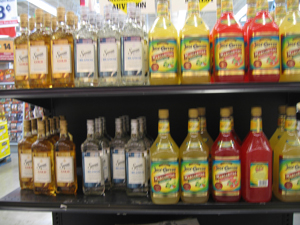
At 3:00 p.m. sharp, my cousin announces that we’re leaving immediately in order to avoid the rush-hour traffic. My cousin’s husband says that we can’t leave his house without first drinking some tequila together. That would reflect poorly on their hospitality. Besides, how could I go to Mexico and not drink tequila?
As the guest of honor, he served me tequila in his very own special tequila shot glass that was wrapped in specially treated tan leather with his name embossed on the leather. How could I say no to this shot of tequila? So we all had a shot of tequila as we were standing to leave. Sure enough, we all start talking about when my cousin came to visit Chicago in 1979. As luck would have it, I was in California in the Marines at the time. So we all sit down to hear about her trip to Chicago and how she almost saw snow because the weatherman predicted a snowstorm, but then there was only a light dusting of snow.
Of course, this called for another shot of tequila! Which no one refused, including me because I always try to be polite and eat and drink everything that is served to me. (You’d be surprised at how polite I can be when food or tequila is involved!) Then it occurs to our host that if you drink tequila you should drink it properly. So he serves us another shot of tequila, but this time he passes around a bowl of lime slices and a salt shaker. That’s how Mexicans really drink tequila! You squeeze some lime juice on the side of your fist, shake some salt on the lime juice, you drink the tequila shot in one gulp, and then lick the lime juice and salt afterwards. Well, we down a few more tequila shots the proper Mexican way and then our host said he had to go to work to take care of some business, but when he returned, he would bring back some food for supper.
The tequila had long ago been consumed and we were left to our own devices to entertain ourselves. Actually, for Mexicans like my aunt, my cousins, and I, we merely entertain ourselves by talking about what we did in the past since the last time we saw each other. In fact, I spent most of my trip just sitting around talking to my relatives bringing myself up to date on their lives. Well, it’s after six p.m. and our host still hasn’t returned. His wife calls him on his cell phone and it turns out that he’s stuck in rush-hour traffic. When he finally returns, he returns empty-handed. We’re all extremely famished by this time. So we all pile into two minivans and go to their favorite restaurant in town. We eat supper and spend a couple of hours talking over our food. By the way, we’re still saying good-bye since three p.m.! We eventually return to my cousin’s house about 9:30 p.m.! However, we did manage to avoid Mexico City’s infamous rush-hour traffic! I have to admit that it was my longest good-bye ever, even by Mexican standards. But it was also one of the most entertaining.
Okay, let me just blurt this out and be off. ¡Adiós!
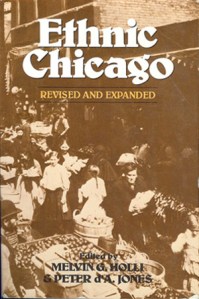
When I was growing up I never heard the word “Chicano.” No one in my family used it and I never heard it in the neighborhood even though there was a sizable Mexican population in the Back of the Yards neighborhood. I’m reminded of this because I was just reading Ethnic Chicago edited by Melvin G. Holli and Peter d’A. Jones, Grand Rapids, Michigan, William B. Eerdmans Publishing, 1984.
What reminded me of never having heard the word “Chicano” was Chapter VIII written by Louise Año Nuevo Kerr titled, “Mexican Chicago: Chicano Assimilation Aborted.” She uses “Chicano” throughout the chapter to refer to Mexicans who came from Mexico illegally, who were part of the bracero U.S.-Mexican agreement during WWII, were from Texas and therefore were American citizens, or had ancestors from Mexico.
So I’m thinking back to the very first time when I heard “Chicano” and I remember I first heard it at Divine Heart Seminary in Donaldson, Indiana, when I was a freshman. There were only three Mexican students out of 130 at DHS: Fred Casillas from Gary, Indiana, Tony Hernandez from Los Angeles, California, and me, from Chicago. There was also Hiram De Jesus, a Puerto Rican from Cleveland, Ohio.
I remember Ken Jones, an African-American who was from Detroit, telling me when we had our first family visits that he wanted me to meet his mother. He insisted that I meet her for the whole week leading up to our first family weekend visit. Well, when I finally met her, I was surprised that she was Mexican. That explained why Ken wanted me to meet her so badly. Hiram also wanted me to meet his mother, whom I did. I was surprised that she was so young. She was only twenty-nine even though Hiram was fifteen. Fred and Tony were sophomores and Hiram and I were freshmen. Tony was my big brother when I visited DHS in eighth grade. Hiram and I were in Enrico Mordini’s Spanish II class with other sophomores.
Anyway, one day, Fred calls me a Chicano, but I had no idea what he was talking about because I had never heard the word before. He then explained it to me. None of this made any sense to me at first. I attended a Lithuanian Catholic school with mostly Lithuanian and Mexican students in a neighborhood that was home to Lithuanians, Mexicans, Germans, Italians, Poles, and other ethnic groups that in general maintained their ethnic customs, but got along well with everyone else. This Chicano movement that Fred described to me was something that was entirely new to me given where I had grown up.
One day after Fred returned to DHS from a weekend visit home, he wore a brown beret with a patch that said “Chicano Power” and a picture of brown clenched fist with an iron manacle with a dangling chain that had a broken link on the end. He also wore a white T-shirt with the same exact message and image. Fred made me feel like I was some sort of traitor for not having the same feelings as him about the Chicano movement.
Well, when I went home one weekend soon after, I had my father take me to Old Town to Bizarre Bazaar where I bought the same beret, “Chicano Power” patch, and T-shirt that Fred had. My father didn’t understand why I wanted these items, but he bought them for me anyway. He asked me to explain what they meant, but he didn’t seem to understand and didn’t give them too much importance. When my mother saw me wearing the beret with the patch and the T-shirt, she thought I had joined a gang. None of my friends understood why I would wear “Chicano Power” even after I explained it to them. All their parents thought that I had joined a gang, just as my mother did. Everyone misunderstood me. Luckily, I was only home for the weekend.
When I returned to DHS, Fred was so proud of me. Tony didn’t think much of my commitment to the Chicano movement. Since Hiram was Puerto Rican, it really didn’t affect him in any way. Surprisingly, none of the priests or brothers acknowledged my new apparel, much less reproach me for it. In general, unless you violated the seminary rules or you committed a sin, everyone pretty much left you alone. The only one who was really excited about all this was Fred. I was disappointed that I went through all this trouble to buy these items and no one, other than Fred, really cared.
After a while, I stopped wearing the beret and the T-shirt. When I returned home for the summer, they stayed in my dresser drawer. I never again heard anyone in Chicago mention the word “Chicano.” Everyone I knew in Chicago was American.
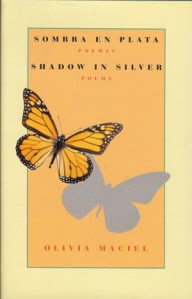
Olivia Maciel is a poet who was born in Mexico City, but has lived in Chicago a long time. She has written several collections of poetry over the years. She writes poetry in Spanish, but her books include an English translation on the facing page. I recently read two of her collections: Sombra en plata [Shadow in Silver], Chicago, Swan Isle Press, 2005, and Luna de cal [Limestone Moon], Chicago, Black Swan Press, 2000. All her books are available for purchase on Amazon.com.
I first met Olivia in one of my graduate classes at UIC. We took several classes together while earning our master’s degrees. She graduated from the University of Chicago with a Ph.D. When Octavio Paz died, she published an article about her reactions to his death that appeared in the Chicago Tribune. We occasionally bump into each other at UIC because we are both Spanish lecturers there. I really enjoy talking to her because she’s so creative. Sometimes, she begins writing poems as we speak. She says that I inspire her when we talk. I asked her if she would hire me as her muse.
I attended Divine Heart Seminary in Donaldson, Indiana, despite my protests. It all started when I was in the seventh grade at Holy Cross School. Two seminaries, Divine Heart Seminary and Divine Word Seminary, sent priests to talk to the boys about vocations. When I was thirteen, I thought I might be interested in becoming a priest. After all, I attended mass almost everyday. My father and all his brothers attended a seminary in Montezuma, New Mexico. My aunt was a nun, and two of my uncles were priests. But I had my doubts about the priesthood because I would have to take vows of obedience, poverty, and celibacy. Celibacy? Now wait a minute. The vow of celibacy was my main stumbling block. I knew that someday I would like to have children. Anyway, I gave both priests my name because I said I might be interested in the priesthood. Then, I forgot all about their visit.
In the eighth grade, Divine Heart Seminary called me to see if I wanted to visit their campus. They would come to my house to pick me up and drive me all the way to Donaldson, Indiana. How could I say no? Before I went to visit DHS, I truly wondered if I wanted to become a priest. I was an altar boy then and a very devout Catholic, but I did have my mischievous side. Overall, I considered myself a good person.
At the Divine Heart, I saw how the seminarians lived. I spent one weekend there and got a taste of seminary life. I slept in the dorm where I would sleep as a freshman and I got a tour of the campus with the “big brother” that I was assigned. I got to see how real seminarians lived! Well, I was disillusioned by the seminary life. I didn’t think that potential future priests should behave like these seminarians.
At Holy Cross, I was taught that just about everything was a sin: swearing, smoking, playing pool, etc. Well, I was shocked to hear the boys swearing when their were no priests or brothers present! And they were going to be priests? Then, my big brother showed me the smoking lounge. These boys were allowed to smoke? I thought smoking was a sin. But my biggest shock of all was that they had pools tables! Not one or two pool tables, but many pool tables. In fact, there were several rooms that were exclusively reserved for playing pool. At that moment, I decided that future priests should not behave like these seminarians. I absolutely knew that I would not attend this seminary because they lived sinful lives.
Later, when I had forgotten all about my visit to Divine Heart Seminary, Sister Cecilia, the principal, called me outside of the classroom to talk to me. I thought I was in trouble for something I did. She told me that DHS called and wanted to know if I was still interested in attending their seminary. I immediately told her, “No.” She said, “You’re just too shy to admit it.” We went back into the classroom, I sat down, and she addressed the class, “Well, boys and girls, you are all very fortunate! David has received a vocation. He will become a priest someday! Next year, David will be attending Divine Heart Seminary in Indiana.”
Well, that little announcement truly changed my life forever. I sure didn’t want to attend any seminary, let alone Divine Heart Seminary. Soon, my classmates started calling me Father David. In the neighborhood, the kids would see me coming and mutter under their breath, “Watch what you say. Here comes the priest.” The girl I really liked in the class lost all interest in me. The next morning when I served mass as an altar boy, Father Gilbert congratulated me on my vocation. I told him that I didn’t want to become a priest, but he didn’t believe me and said that I was just being modest.
I told my father about what had happened to me with the seminary. That’s when I learned he, too, had attended a seminary for many years. He was actually proud of the fact that I would also attend a seminary. When my mother found out about my “vocation,” she told me that she was so proud of me. No one would listen to me! I didn’t want to attend Divine Heart Seminary. I had narrowed down my choices for high school to Leo High School or De La Salle High School. Try as I might not to attend DHS, I was forced to attend DHS. Before I even started school there, I had already made up my mind that I would never become a priest. Yet everyone was so proud of me and the fact that I would attend Divine Heart Seminary!



 Chicago USA