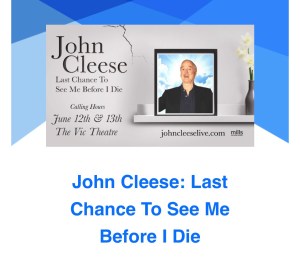
I had one last chance to see John Cleese before he died. I hope I don’t sound rude and obnoxious, but that’s how John Cleese billed his show at The Vic that I saw on Thursday, June 13, 2024. He was very entertaining even when referring to his impending mortality.
I wasn’t sure what to expect from his performance. After I bought the tickets, I read that sometimes John Cleese showed the movie Monty Python and the Holy Grail at the end. Well, I could watch the movie on my own if I wanted to see it since I own it on DVD along with other Monty Python shows and movies.
Instead, John explained some of the background to their shows and movies, which was very entertaining. He explained how the family name had actually been Cheese, but his grandfather (or maybe it was his great grandfather) decided to change the family name to Cleese (but it rhymed with cheese).
I really enjoyed the show! He showed clips from previous TV shows. He also told some politically incorrect jokes, which the audience loved. When you’re old you can get away with such humor. Plus, the audience consisted of diehard Monty Python fans who were accustomed to such humor. Some of those offensive jokes were very funny and the audience roared with laughter. I know you would like to hear a few of those jokes, but I dare not repeat them.
Whether or not John Cleese will die now that I have seen him, remains doubtful. I’m sure I’ll cry, “False advertising!” when goes on tour again. We shall see.
One of my favorite comedy clubs is The Comedy Vault in Batavia, Illinois. I used to go there for their open mic because there was usually a decent sized audience for an open mic. This was also my way of sociallizing because all the comedians got to know each other and looked forward to meeting up again.
My favorite part of The Comedy Vault decor was the comedian quotes that were posted on the wall. All the good comedians have a few lines that can be quoted out of context and still sound funny. Well, I have compiled the comedians’ quotation that decked the walls of The Comedy Vault. Here they are, in no particular order.
My psychiatrist told me I was crazy, and I said I want a second opinion. He said, “Okay, you’r ugly, too!
–Rodney Dangerfield
I’ll tell ya, in New York City, where I’ve lived for far too long, “fuck” isn’t even a word, it’s a comma.
–Lewis Black
If you don’t think drugs have done good things for us, then take all of your records, tapes, and CDs and burn them.
–Bill Hicks
If you’ve never seen an elephant ski, you’ve never been on acid!
–Eddie Izzard
There are only three things women need in life: food, water, and compliments.
–Chris Rock
Rice is great if you’re really hungry and want to eat two thousand of something.
–Mitch Hedberg
I support building a wall if it’s around the state of Louisiana because thos people are out of their fuckin’ minds. You fuckin’ swamp people, we don’t need you.
–Tom Segura
A day without sunshine is like, you know, night.
–Steve Martin
When did the avocado toast become the new crack cocaine?
–Whiney Cummings
Don’t bother me while I’m eating, or when I’m coming out of the crack house or something. Just let me get going.
–Wanda Sykes
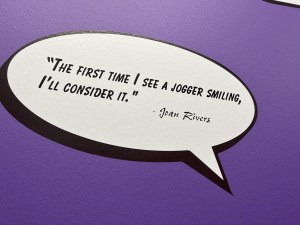
The first time I see a jogger smiling, I’ll consider it.
–Joan Rivers
Gun control? We need bullet control! I think every bullet should cost five thousand dollars. Because if a bullet cost five thousand dollars, we wouldn’t have any innocent bystanders.
–Chris Rock
I don’t like letting my friends drive drunk, but I was smoking a joint so I couldn’t say shit to the guy.
–Dave Chappelle
You don’t know anything about pain until you’ve see your own baby drowned in a tub. And you don’t know anything about how to wash a baby.
–Anthony Jeselnik
I believe that if life gives you lemons, you should make lemonade… And try to find somebody whose life has given them vodka and have a party.
–Ron White
I don’t have a girlfriend. But I do know a woman who’d be mad at me for saying that.
–Mitch Hedbeberg
Ah, yes, divorce… From the Latin word meaning to rip out a man’s genitals through his wallet.
–Robin Williams
I came from a real tough neighborhood. I put my hand in some cement and felt another hand.
–Rodney Dangerfield
You want to know how big of a pig your man is? He’s however big of a pig you gave him permission to be. Every man has unlimited pig-tential.
–Tom Segura
7 percent of all statistics are made up on the spot.
–Stephen Wright
All white people talk about when they get high is other times that they got high.
–Dave Chappelle
Honesty may be the best policy, but it’s important to remember that apparently, by elimination, dishonesty is the second-best policy.
–George Carlin
Reality is a crutch for people who can’t cope with drugs.
–Robin Williams
The worst kind of non-smokers are the ones that come up to you and cough. That’s pretty fucking cruel, isn’t it? Do you go up to cripples and dance, too?
–Bill Hicks
I don’t even want to, like, lose weight to live long or be hearlty. I don’t. I just want to be able to make fun of fat people again.
–Tom Segura
I hate when women compare men to dogs. Men are not dogs. Dogs are loyal. I’ve never found any strange panties in my dog’s house.
–Wanda Sykes
Think of how stupid the average person is, and realize half of them are stupider than that.
–George Carlin
I went to rehab (for alcoholism) in wine country, just to keep my options open.
–Robin Williams
I think it’s the duty of the comedian to find out where the line is drawn and cross it deliberately.
–George Carlin
Employee of the month is a good example of how somebody can be both a winner and a loser at the same time.
–Demetri Martin
My fake plants died because I did not pretened to water them.
–Mitch Hedberg
A bank is a place that will lend you money if you can prove that you don’t need it.
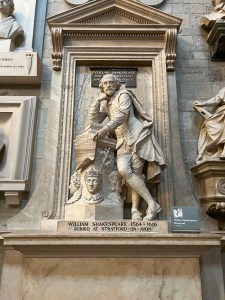
William Shakepseare, Westminster Abbey, London, England
As you may have gathered from reading my blog, I am a voracious reader. I’m mainly enjoy reading fiction, but I will read almost anything. I even read candy wrappers I see on th ground.
I especially love to read novels. The novel to which I can most relate, although it is not my favorite, but I have read it four times, is Jude the Obscure, by Thomas Hardy. Jude, the title character, tries to compensate for his lack of a forma education by immersing himsef in books that will provide him with a good education. For the longest time, I lacked a formal education, so I read all the books that would constitute a sound educational background. I also read the complete works of William Shakespear on my own. Eventually, I went back to school and majored in English.
As an English major, I discovered that I had already ready many of the required readings on my own. However, I did add more authors to my reading list of books read. I enjoyed reading the biographies of the authors I read. I soon discovered that many of them had something in common: They were all either buried or memorialized in Westmister Abbey. Back then, I thought I would enjoy going to Westminster Abbey to make a connection with those writers, but I never thought that would be possible.
Well, I have reached that point in my life where I was able to go to Westminster Abbey. I have never done much international travel, other than to Mexico to visit my family. My wife and daughter wanted to go to Rome last December. I was reluctant to go to Rome, mainly because of our language barrier. I suggested that we go to London, mainly because I was an English major and I speak English. My wife and daughter agreed.
My wife’s friend told she should prepare for the trip to England by watching the TV series The Crown. I realized then that I was doing it all wrong! I was watching Mr. Bean and Benny Hill!
So there we were in London, England, the birthplace of the English language. The streets were filled with lots of tourists, very few of whom were speaking English. But I have finally arrived at Westminster Abbey! I was enthralled, motivated, and inspired by being in the presence of so many great minds! I saw the names of many of the writers I had read. I had read most of them! Except for William Longfellow, Henry James, and T.S. Eliot, they were all English.
I took pictures of almost all the writers. Here’s a list of the writer’s whose name I saw at Westminster Abbey and that I had read at least once, in no particular order:
I was having lunch with my son Alex and my brother Danny when I thought that we should go to a baseball game. And I can tell you the exact date of our lunch. July 29, 2014. You will learn why I remember the exact date as you read on.
Anyway, we’re having lunch and I suggest that we go to a baseball game. I believe the only Chicago baseball team playing that day was the Cubs. My son and I are White Sox fans, but we’re not anti-Cubs fans. In fact, we’re Chicago fans! My brother Danny really isn’t into sports but has gone to baseball games with us as a family. So, I suggest that we go to a Cubs game that evening.
My son agrees, but Danny immediately says no. He says, “The last time I went to a baseball game with you, it was the longest baseball game ever!”
Then I remembered. It was my birthday and my youngest brother Joey suggested that we go to a White Sox game for my birthday. We went on May 8th because my birthday was the next day on May 9th. So, we, my father, brothers Danny, Jerry, Rick, Joey, my sister Delia, and I went to the White Sox game on May 8th , 1984.
Well, the game went into extra innings with a tie score and at midnight, the officials suspended the game to be continued the next day. We returned to Comiskey park the next day, my birthday, May 9th. The game finally ended when Harold Baines hit a homerun in the 25th inning for the White Sox victory of 7-6. This was the longest baseball game ever; it took 8 hours and 6 minutes to complete. And the regularly scheduled game for that night also went into extra innings!
Flashforward to our lunch with my son and brother. Danny says, “I don’t want to go to another long baseball game!”
“What are the odds of that ever happening again?” I asked. He still refused to go with us. “You’re going to miss out on a good game!” I said.
My son and I went to the Cubs game that night. You’ll never guess what we witnessed! The longest Chicago Cubs game in club history! My brother Danny called it when he refused to go to the game with us.
Well, the game lasted 16 innings and ended at 2:00 A.M. after 6 hours and 27 minutes of play. I texted my brother and he was joyful that he didn’t come to the game with us! I was ecstatic that I had witnessed the two longest baseball games in Chicago history.
A couple years ago, my son Alex told me that he really didn’t believe me about the longest White Sox game ever. But then he saw the replay of the game on TV. I didn’t watch the game, but I told him that the game ended when Harold Baines hit a homerun. It was only then that he believed me.
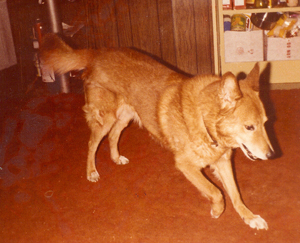
Duke, 2509 W. Marquette Road, Chicago, Illinois 60629
My wife keeps asking me which was your favorite dog? And I keep answering, “Duke!” She thought I would say Pluto or Earl, but I have very fond memories of Duke.
Pluto was my wife’s dog that she bought years before we married. So Pluto was actually my step-dog. I loved Pluto a lot, but I kept recalling Duke everytime I played with Pluto. I took such good care of Pluto that he soon was promoted to my dog from step-dog. My wife was a little jealous. Pluto lived to be 18 years old. My wife was very distraught at Pluto’s passing.
She insisted that we get another dog, but I liked not having to walk or care for a dog. I enjoyed the freedom to eat in peace. My wife kept insisting that we get another dog. When her birthday rolled around, she said, “If you get me a dog for my birthday, you won’t have to give me any other birthday presents!” Reluctantly, we went to PAWS Chicago to adopt Earl, a rescue dog from Austin, Texas. I can only imagine why they named him Earl. Probably because of the troublemaker from the TV show My Name Is Earl.
I must admit that I enjoy having Earl because he was easy to housebreak and he is a lot of fun to have around. My wife loves Earl so much that she says that Earl is the best dog she has ever had. So my wife asks me, “Is Earl the best dog you have ever had?” I think about it for a while, and then I remember Duke. I say, “Duke was the best dog I ever had.” My wife is surprised and disappointed by my response.
Well, Duke was a stray street dog that found us in 1970. We lived at 4405 S. Wood Street and we attended Holy Cross School at 4547 S. Wood Street in Chicago. My brothers and I always walked to and from school together. As the oldest brother, I was charged with the safety and welfare of my little brothers while our parents were at work.
One day on our way home from school, we see a dog standing on the southeast corner of 45th and Wood Streets. He looks friendly and he waits until we reach him. We pet him for a while and then we continue walking home. Surprisingly, Duke willingly follows us home. At home, we didn’t bring him into the house, but we did give him a bowl of milk with bread in it on the back porch. We play with him in the backyard until my mother came home. My mother doesn’t believe us when we tell her the dog followed us home. She orders us to to take the dog out of the yard and close the gates so he wouldn’t come back.
The next day, we’re walking home from school again, and we see the dog waiting for us on the corner. We pet him and then start walking home. The dog follows us home again. We feed him and play with him in the backyard until my mother comes home. Again, she orders us to get rid of the dog and we do.
That weekend, I went to Divine Heart Seminary for a visit to see if I was interested in attending the seminary. I learned that I wasn’t interested at all. When I returned home, we were eating dinner when I noticed the dog was under the table. I was very surprised to see him in the house because my mother was adamant that we would not have a dog! I asked my mother, “What’s he doing here?” She said, “He’s our dog now!”


 Chicago USA