Vosotros


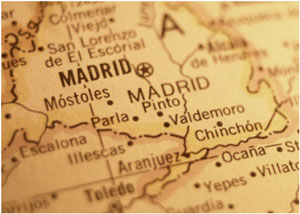
España

Sometime during the first week of every semester, my Spanish students always ask me if they have to learn the vosotros form for verb conjugations. No high school Spanish instructor seems to teach the vosotros form. Now that I think of it, Señor Mordini never made us learn the vosotros form at Divine Heart Seminary. And Señor Mordini was from Spain! I didn’t have to learn it in college either.

Now as a Spanish teacher myself, I find this utterly amazing since there are more than forty million Spanish speakers who use the vosotros form. If you’ve ever watched Penelope Cruz movies, surely, you’ve noticed that her character always calls her friends and acquaintances vosotros. So, for the sake of Spanish cinema fans, I always teach the vosotros form even if the students won’t be tested on it. Every Spanish student should at least recognize the vosotros form when they hear or read it, so they’re not totally lost. Like I was in the days of my youth.

When I was a boy, our family often went to mass in Spanish. Jesus, Jesucristo in Spanish, always spoke to his apostles using the vosotros form. I was puzzled by what he was saying when he did. For example, Jesus told his apostles, “No penséis que he venido para traer paz a la tierra” on one occasion, and on another, “Id por todo el mundo y predicad el evangelio a toda criatura,” which confused me. I asked my father what Jesus had told his apostles and my father explained to me that in Spain they used the vosotros form. I found it hard to believe that Jesus had ever been to Spain! But I didn’t dare question my father.

So, what exactly does vosotros mean? It means “you” plural. When you translate “you” into Spanish, you choose from tú, vos, vosotros, vosotras, usted, or ustedes. In Spanish, you must also choose between the formal and the familiar. If you are speaking to someone you don’t know personally or they are in a position of authority over you, you must call him, her, or them usted or ustedes. Family members, friends, or acquaintances whom you know well you call . If there are more than one , you are supposed to use vosotros or vosotras. However, in the Spanish-speaking countries of Latin America, everyone uses ustedes instead of vosotros(as). So, if I’m speaking to my cousins or my friends, I call them ustedes instead of vosotros, as they would do in Spain.

So, ustedes could be used for both formal and familiar situations. Sometimes, this results in absurd situations. For example, people who own a cat will call it . If they own more than one cat, they call them ustedes when vosotros would be more appropriate in this situation. Someone from Spain will laugh if they hear you calling your pets ustedes!
DDR

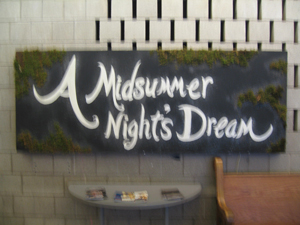
A Midsummer Night’s Dream


UIC Theater, 1044 W. Harrison Street, Chicago, Illinois

I went to see A Midsummer Night’s Dream at the UIC Theater today. Our university has a theater department, so I like to see plays that they stage. I usually go to the afternoon performances because I like going to the theater in the afternoon. That’s not the usual time to see a play. Unless you’re going on a school field trip. In fact, the theater is usually filled with students who come on school field trips. And they usually enjoy the plays presented. I’m not sure if they like the plays or they’re simply happy to be away from their school. I enjoy the plays because I get to stay at UIC a little longer.

Of course, I also love Shakespeare! I had just seen the movie version of A Midsummer Night’s Dream a few weeks ago. Although I thoroughly enjoyed the movie, this live performance topped the movie! Watching actors perform in the flesh is always much better. These actors were very professional and delivered convincing performances.

I loved the music they added to the performance. It was fitting because they conveyed the dream theme. From the Eurythmics to Lady Gaga. The Flower Duet by Leo Delibes was also very well-placed. They also played Louis Armstrong, Nessun Dorma. I really can’t remember all the songs they played, but I really enjoyed them in the context of the play.

They were true to Shakespeare’s words, but they used modern gestures to express themselves, much to the audience’s delight. My favorite was when Oberon hit Demetrius and then did the Sammy Sosa post-homerun celebratory gestures. The audience roared at this! I loved how director Karen Kessler focused on the comedy aspect of the play. This updated version was hilarious, and the audience laughed in all the right places. I laughed so loud and so hard that I was glad my sons weren’t with me to tell me, “Dad, you’re embarrassing us”!

DDR

Driving lessons


My father’s camioneta

When I recall that I learned to drive from my father, I consider myself incredibly lucky to still be alive. I took driver’s ed at Divine Heart Seminary in Donaldson, Indiana, but I only got to drive the minimum required hours. My father loved teaching everyone how to drive, so he took me out driving. The only one who ever refused to take lessons from him was my mother. She didn’t like him telling her what to do. Especially, since she knew his every bad–and dangerous–bad driving habits. My father had some extremely dangerous driving habits that he tried to teach everyone he taught. Including me! Since I was only sixteen, I had to follow his instructions carefully or risk never driving again. I had a permit and I wanted to drive!  

I was an extremely poor driver in driver’s ed. The first car I drove was a 1971 Pontiac Firebird with a manual transmission. We were all excited about driving a sports car! I stalled the engine every time I drove. The instructor told me I would be fine once we started driving the Chevy Caprice with an automatic transmission. Everyone was happy about the automatic transmission because the engine stalling stopped. Until I got behind the wheel. Somehow, I still managed to stall the engine! But that was the least of my worries. I didn’t know how to yield at yield signs, and from years of watching my father drive, I didn’t come to a complete stop at stop signs. I thought stopping was optional because my father never came to a complete stop at a stop sign. Now that I think of it, he never completely stopped at red lights either! Whenever the light turned red, he would slowly stop a couple car lengths from the intersection and slowly creep forward until the light turned green.  

I was surprised that my father allowed me to drive his brand-new lime green 1971 Ford Maverick. He was so proud that he was teaching his oldest son how to drive!  I was even more surprised at some of the driving maneuvers de demanded of me! For example, he would tell me to take short cuts through alleys. When I came out of the other end, he wanted me to lay on the horn in case any car or pedestrian was at the mouth of the alley. He taught me about lane position when making right turns. If you make a right turn, my father told me, you must get in the right lane. Then, when you get close to the intersection, you swing out wide to the left before you turn! I almost crashed the very first time I tried my father’s technique. My father always made his right turns like this. I’m surprised he didn’t have more accidents.  

He also told me to use a turn signal when changing lanes. But in Chicago, sometimes it was better not to let the other drivers know your intentions. I’m not sure why. I never really understood his explanation. If you got to and intersection without any traffic controls and the other driver signaled you to proceed before him, my father told me to never go. He just wanted to crash into you. To this day, I always give the other driver the right of way.  

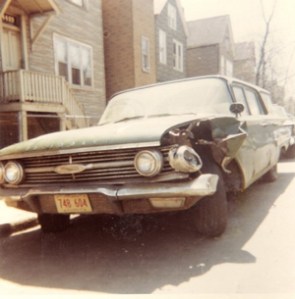
My father always had trouble staying in his lane. On the expressway, in the right lane, he would exit on the right if he didn’t focus on staying in his lane. Before I started driving, I thought staying in your lane was the most difficult driving feat possible. My father would make everyone be quiet whenever we approached exit ramps. In the picture of my father’s station wagon, you can see the result of his not staying in his lane. he was driving northbound on Damen Avenue at 47th Street. That was the site of the infamous Damen overpass in Back of the Yards. The left two lanes took you over the overpass. However, the right lane allowed drivers to veer right and avoid going on the overpass. Well, my father was in the right lane when the exit lane pulled him to the right. Unfortunately, he crashed into the concrete barrier dividing the lanes despite the flashing yellow warning light and warning sign. Luckily for me , he was alone while driving.  

He parked for about ten minutes to calm down from the trauma before he came home. I was the first one to see him and his fender damaged. I was sorry I asked him what had happened. It took him about five minutes to explain this two-second traffic crash. Then, he told me to get in the car and he took me back to the scene of the accident. He did a reenactment of the accident. I was riding shotgun and not wearing a seatbelt because back then no one wore seatbelts because most cars didn’t have seatbelts. As he was showing me his path before the accident, he almost crashed into the concrete barrier again! That really shook him up and he had to pull over for a few minutes to calm down before we could drive home. I still have some of the driving habits that my father instilled in me. And that’s why I say that I’m lucky to be alive!  

DDR

Chicago flag


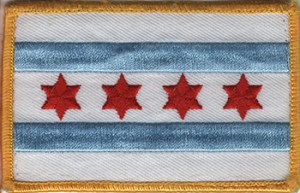
My uniform patch of the Chicago flag

Everyone recognizes the Chicago flag, but not all Chicagoans know what our beautiful Chicago flag represents. Once I was eating lunch with my friend Mike when some tourists from France saw the patch of the Chicago flag on our uniforms. They wanted to know what the symbols on the flag meant. I’m embarrassed to admit that I didn’t know what the three white stripes represented back then. Mike explained all the symbols to the French tourists, much to their satisfaction. They were genuinely impressed that they had finally met a Chicagoan who knew what the Chicago flag represented. The French tourists left the restaurant, and Mike and I continued eating lunch. When we asked for the check, the waitress told us that the French tourists had paid for our meal. Talk about the value of a little knowledge!

So, the three white stripes represent the three sides of Chicago: south side, north side, and west side. Notably, there is no east side of Chicago. That’s Lake Michigan! The two blue stripes represent the two bodies that help define Chicago: the Chicago River and Lake Michigan. However, I have also heard that the two blue stripes represent the two branches of the Chicago River. Don’t you just hate it when there are two competing explanations? Each red star represents an important historical event in Chicago history: the 1812 Fort Dearborn Massacre, the 1871 Chicago Fire, the 1893 World’s Fair, and the 1933 World’s Fair.

In our era of politically correctness, the Fort Dearborn Massacre has been renamed The Battle of Fort Dearborn. It’s only a matter of time before this “encounter” gets softened even more. What’s next? The Fort Dearborn Cultural Exchange?

Now that you know the meaning of the Chicago flag, help share your knowledge of the city of Chicago and the Chicago flag to any tourist–whether from a foreign country or another state of the USA–who visits.

DDR

Nihil


Talk about potential!

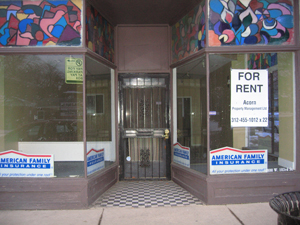
Sometimes I have crazy ideas. Okay, maybe a little more often than sometimes. If you’re a regular reader, you know what I mean. Well, my latest idea–actually, I’ve thought about this one for years–involves renting an empty storefront. I would paint a simple sign in the window: NIHIL. I would set up a desk with a computer where I could write. I would also surround myself with my books in bookcases. There would be inviting desks, tables, and sofas for the curious to come in and be creative. Or, if they’re not creative, reading would also be permissible. If no one came in, I would sit there in public view writing my blog or working on my website. Anyone would be welcome to come as long as no one talks and interrupts the creative process of anyone present.

For the uninitiated who entered and asked, “What does ‘Nihil’ mean?” I would say, “Nothing.” Or perhaps, I would say nothing. And they would catch on to the fact that they were not supposed to talk. I would point to the available furniture. If they left, so much the better. This way I could keep writing. If, however, they stayed quietly, I would feel as if I had accomplished something.

This is a crazy idea for me because I do that at home right now. Whenever I’m at home I sit at my computer writing something or other without any interruptions. Or I read. Some people can’t do anything productive at home, but not me. I’ve always been at my most productive while at home! Besides, I can’t afford to rent an empty storefront.

DDR