Flor de Mayo


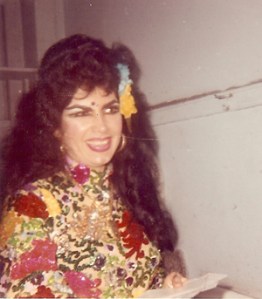
Irma Serrano, The Peoples Theater, Back of the Yards, Chicago, Illinois.

My mother always helped Mexicans who were new to Chicago. Whenever people threw away furniture, I would have to help her bring it from the alley to our basement until she could give it to someone who desperately needed furniture more than us. Many Mexicans came and went from my house because not only would my mother give them furniture, but she would also advise them on how to survive in Chicago.

My mother went to Mexico about once a year. She loved Mexico so much because the Mexicans in Mexico loved her and envied her because of her success in America. One year when she returned from her Mexican vacation, I overheard her calling the Spanish TV station and I asked her why. She had met a single Mexican mother with a one-year-old daughter. I don’t remember the woman’s name, but she also played guitar and sang songs she wrote herself. My mother had convinced this woman to come to Chicago because my mother knew people at the radio and TV stations. Important people!

So anyway, my mother told this woman she would have a promising musical career if she left Mexico and came to Chicago. Somehow, my mother convinced this woman to come to Chicago and she was scrambling to get her an appearance on the radio or TV. My mother was so sure that this woman was an extremely talented musician! I don’t know how she did it, but after a few days, my mother got her on the radio and on a TV show. I remember she rehearsed at our house a few times before her appearance. I was only about ten years old at the time, but I thought she performed very well, and she was so beautiful!

Sometime after her public appearances, she returned to our house to show us her new 45-rpm record. I don’t remember how well it sold, but she had a record! Her manager gave her the stage name of Flor de Mayo. We were all excited that Flor had made it, but none more excited than my mother who had exaggerated her connections to get Flor de Mayo to come to Chicago all the way from Mexico.

At my mother’s wake, many people, most of them Mexicans, came to pay their last respects to my mother. We had a three-day wake, which families no longer have. I saw a lot of people whom I hadn’t seen for years. The biggest surprise arrival was a woman who approached me, shook my hand, hugged me, and said in Spanish, “If it wasn’t for your mother, I wouldn’t be here in Chicago!” She was rather plump by then but still beautiful. I recognized her voice, but I couldn’t place her, so I asked her who she was. She said, “Flor de Mayo.”
DDR

Mexican hot chocolate


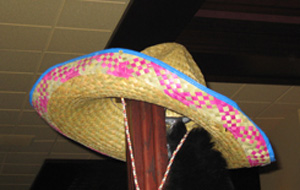
Mexican sombrero in a downtown restaurant

I have always loved Mexican hot chocolate. I mean real Mexican hot chocolate, made by real Mexicans. I generally drink it during the winter months, but I myself have never made Mexican hot chocolate in my life. In fact, I have never heard of a Mexican male making Mexican hot chocolate outside of a restaurant.

Usually, my mother or abuelita made it at home. They would bring the water in the pot to a rolling boil and then drop the brick of chocolate into the boiling water. Stir it with that wooden thing with the wooden rings–okay, I don’t know the Spanish name for it–that cosita until the chocolate brick melted. I loved the hot chocolate! Especially after all the TLC that went into it. You see, whenever my abuelita or mother made the hot chocolate, they would dip a spoon into it to taste it to see if it tasted good. They would dip the same spoon several times after removing it from their mouth. Not very hygienic, but full of TLC.

When I was married, my ex-wife would also like to make hot chocolate, too. Usually, unannounced. Using the same traditional Mexican recipe and Mexican TLC techniques. Well, our stove was next to the water heater and when my son was four years old, I would tell him the water heater was hot, hot, hot. “¡Ay! ¡Ay! ¡Ay!” And he would repeat “¡Ay! ¡Ay! ¡Ay!” and pull his hand back as if he had burned it.

Well, one day, I heard my ex tell my son, “Ask your father if he wants hot chocolate.” My son came into the living room and asked, “Dadá, you want ¡Ay! ¡Ay! ¡Ay! chocolate?” I had a tough time containing my laughter, but I could see the logic of his thought process and it made perfect sense! Now, I only drink ¡Ay! ¡Ay! ¡Ay! chocolate.

DDR

English only, please


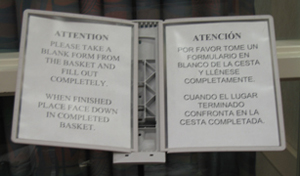
A poorly translated sign at Mercy Hospital.

We have so many foreign words in English that it’s quite pointless to insist on “English Only” or that English be made the official language. For one thing, what do we do about all the Spanish geographical names of the American southwest? There are too many names to translate to English.

And the reason they have Spanish names is because the Spaniards gave them Spanish names when the American southwest was still part of the Spanish colony called Nueva España (New Spain). Just think of the California cities called San Diego, Los Angeles, San Francisco, and Sacramento. There is a place in California (named in Spanish by the Spaniards) called La Brea Tar Pits. In Spanish La Brea means tar pits. So if we translate the name into English, we get The Tarpits Tarpits! We could do that for all the cities with Spanish names. San Diego will become Saint James, San Francisco, Saint Francis, and Sacramento, Sacrament! Perhaps this would be an impossible task, but we will eventually translate all those Spanish names into English! Dammit!

And speaking of redundant, I am reminded of the song, “Surfin’ USA” by the Beach Boys. There is a line in the song that says, “You’d see ’em wearin’ their baggies / Huarachi sandals, too.” In Spanish, “huaraches” means sandals, so these surfers are wearing sandals sandals! And then there’s Carlos Santana with, “Yo no tengo a nadie that I can depend on.” Hey, Carlos. English only!

In “Vertigo” by U2, the song begins with some “counting” in Spanish: “Uno, dos tres, catorce.” Either Bono doesn’t know Spanish or he just doesn’t know how to count. One of my students told me that these numbers really are a tribute to U2’s producer who produced albums number 1, 2, 3, and 14. And this reminds me of the song “Woolly, Bully,” by Sam The Sham and The Pharaohs that begins, “One, two, tres, cuatro.” He counts in both English and Spanish, but at least he gets the numbers in the correct order!

DDR

The story of the Spanish “O”


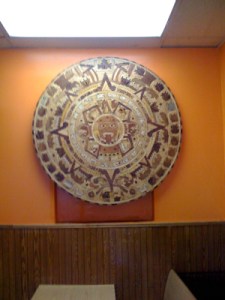
Aztec calendar = O

The letter “O” is an amazing letter in Spanish! “O” makes Spanish, Spanish. In my Spanish class, I demand that all my students to speak Spanish whenever possible.

Once there was a commotion in the classroom and I asked what had happened. When a student told me that his book fell, I asked him to tell me in Spanish. He then said, “El book-O fell-O.”

Merriam Webster’s Collegiate Dictionary even lists “el cheapo” as an entry! That’s the stereotype of the Spanish language: that all the words end in “O.” Do you understand? No problemo! (In Spanish it’s really “problema.”)

How about all those snacks derived from corn tortillas? They all end in “o” with an “s” to make it plural. Fritos, Doritos, Tostitos, Nachos, Chipitos, Crujitos, etc.

However, there are some English words that become Spanish when you add “o.” For example, insect becomes insecto, car becomes carro, Alfred becomes Alfredo, Robert becomes Roberto, but David remains David and under no circumstances does it become Davido. Nothing annoys me more than to be called Davido! False becomes falso, traffic becomes tráfico, and video, well, it stays the same, video. 

But be careful with cool. Don’t say coolo! Adding an “o” to cool will make it culo in Spanish, which requires much care when saying it because it’s a swear word referring to part of the body in the nether region known as the buttocks. ¿Comprendo? [sic]

DDR

New food


I’ll have the Walking Taco.

I am not the most graceful of people. I was just getting this walking and talking thing down pat, when what do you think someone invents? A walking taco! Basically, you get a bag of Fritos piled with chili, lettuce, sour cream, and hot sauce. Walking tacos are very popular at carnivals and local sporting events in the greater Chicagoland area. Personally, I think of tacos as a sit-down kind of food that demands the eater’s complete and undivided attention because they are tricky to eat even while sitting down.

Anyway, I bought a walking taco the other day at my son’s football scrimmage game and I actually tried to eat it while walking; I wanted to see if there was truth in advertising. However, I don’t recommend this at all. Well, I was also holding an umbrella open because of the rain and I was carrying a can of pop, too. The walking taco was very tasty, but difficult to enjoy because I was afraid that I would drop either the umbrella, the can of pop, or God forbid, the walking taco. I accidentally spilled some chili on my shirt and couldn’t wipe the stain off because both my hands were full. Everyone knew what I had eaten. “How was that walking taco?” “Did you get any of the walking taco in your mouth?” Etcetera. My question is, does this qualify as Mexican food or American food?

DDR