Arguments


Chicago, Illinois, 1963

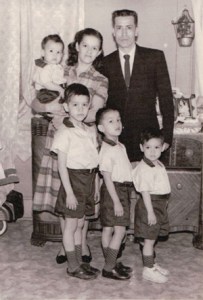
My parents always argued. About anything and everything. If they were together, they would argue. This may sound like I’m exaggerating, but I never, ever once heard them have a normal conversation. They would always argue over money because my mother always wanted more, and my father didn’t make enough. My mother also wanted to work outside of the house because my father didn’t make enough money, of course. My father wanted her to stay home, so they constantly argued over this, whether she was working or not. When she worked, my father lost partial authority over her. There were certain things that mother could do without my father’s criticism if she was a wage earner. For example, she could buy as many records and magazines as she wanted because she had earned the money herself. Of course, when she stopped working, she continued her same shopping habits causing–would you believe it?–more arguments. While the arguments were never physical, they were certainly passionate.

One Sunday morning, my mother woke me up and asked, “Is this a pair of socks?” I could sense by the anger in her tone of voice that not only was she arguing with my father, but that this was a job for me, as their oldest son, to act as a mediator for them. I was still sleepy because on Saturday nights I liked to stay up late watching old movies on TV. My eyes were barely open, and the room was barely lit because the sun was still rising. “Is this a pair of socks?” my mother asked me again in Spanish, holding up a pair of orlon socks in her hand. I said, “It looks like a pair of socks to me.” “No, this is not a pair of socks!” she yelled. I was now fully awake. I was once again trapped by one of her trick questions.

“Look at these socks,” she said. “Do they match?” Well, in the darkness of my bedroom, they looked like they matched. “Your father wants to wear this pair of socks to church. If he wears these socks to church, we’re not going with him. I would rather burn in hell than be seen with your father in church wearing these socks!” My mother always loved to be overly dramatic. “What’s wrong with those socks?” I asked her, knowing full well that I would be the recipient of my mother’s wrath. “You are just as blind as your father! Look! One sock is blue and one is black!”

I couldn’t see the difference of the colors in the darkness, so I turned on the light. Even with the lights on, I thought my mother was holding up a pair of matching socks. If my father had worn those socks to church, no one would have noticed anyway because: 1. They looked like a matching pair of socks; 2. My father’s pants covered up his socks anyway; and 3. In our parish, no one went to church to check out other people’s socks.

By then, the sun was out and my mother took me out to the front porch along with my father. “See?” she said. “One sock is blue and one is black!” As I stared at the socks, I observed that one sock was indeed blue, a dark navy blue, that if you looked quickly, appeared black. And the other sock was black, but it had faded in the wash a little so it had a bluish tint to it. Overall, this looked like a matching pair of socks to me.

As I nervously examined the socks in my hands, my mother awaited my verdict. My father sent me signals through body language that I failed to correctly interpret. My father and I were both doomed. The well-being of my entire family rested on my decision. I felt sorry for my father because he could never dress for Sunday mass without experiencing my mother’s harsh criticism about his fashion sensibility. I could feel my mother glaring at me. I had to make a diplomatic decision. What to do? What to do?

Finally, I stated what I believed to be true of the socks even though I knew I would anger my mother. “This is a pair of socks,” I said. “Wait, Mom! Let me finish. The blue sock is so dark that it looks black and the black sock looks like it has a little blue in it.”

My mother exploded! “I told you to stay out of our arguments,” she yelled at me. Just then, she saw two girls from our parish walking to mass. She called them over to our front porch. “Is this a pair of socks?” she asked them. They both shook their heads. “See?” my mother said to my father and me. “One sock is blue, and the other is black,” one of the girls said. The other girl nodded in agreement. However, the girls couldn’t agree on which sock was the blue sock and which one was the black one, which infuriated my mother.

Well, we eventually went to church that Sunday, albeit a little late. And my father wore brown socks.

DDR

Enrico Mordini


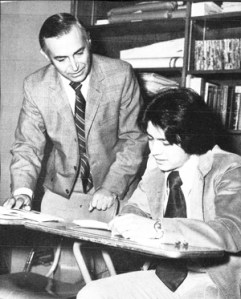
Enrico Mordini with Jerry Rodríguez at Divine Heart Seminary

Years ago, I attended Divine Heart Seminary in Donaldson, Indiana. I recently went to a DHS reunion where my classmates and I remembered our Spanish teacher Enrico Mordini. Señor Mordini was the Spanish teacher who taught me a lot about being Mexican even though he was an Italian born in Italy and raised in Spain. He taught me that there is more than one way to speak Spanish. I never realized there were so many dialects. I was originally in his Spanish I class, but he moved me up to Spanish II because I knew some Spanish. I had always wanted to learn Spanish formally so that I could read and write it. As an aside, when I attended Holy Cross Grade School, since the Lithuanian school didn’t offer Spanish classes, I asked if I could go to Saturday morning classes to study Lithuanian. I was told, “First, you have to learn English.”

Once I started classes with Señor Mordini, I questioned whether I even knew Spanish. He said some words so differently from my mother that it took me some time to recognize them. For example, “to drink” to my mother and me was “tomar” and to Señor Mordini it was “beber.” I had never even heard the word “beber” before! When my mother said “good” in Spanish, she would not say it the same way as Señor Mordini’s “bueno,” but rather, she would say, “güeno” instead. The Spanish word for needle was “aúja” to my mother and me, but to Señor Mordini, it was “aguja.” Our word wasn’t even in the dictionary without the letter g. When I informed my mother of these differences, she said that’s because Señor Mordini spoke “castellano” and not “español.” When I told Señor Mordini what my mother had said, he said that “castellano” and “español” were synonyms for the Spanish language. My mother never really believed him! After all, he wasn’t Mexican. In fact, he wasn’t even Spanish either. He was Italian!

Once while discussing Mexican culture in class, I said that I knew all Mexicans were a mixture of Spanish and Aztec blood. I was shocked when he said that was only partially true because not everyone, in fact, not many people were purely of Spanish and Aztec ancestry. I insisted that I was right. Even my father had told me so. Even after several convincing arguments by Señor Mordini that there were people in Mexico of pure, unmixed Spanish blood , I still didn’t believe him. When I reported this to my mother, she said that not all Mexicans were only of Spanish and Aztec ancestry. In fact, her grandfather had been Irish! “What?” I was so shocked. “Why didn’t you tell me before?” I asked my mother. She just nonchalantly said, “I didn’t think it was important.” Suddenly, I was sixteen and learning for the first time that I had more than just Spanish and Aztec blood coursing through my veins. In fact, I might not even have Spanish or Aztec blood coursing through my veins. I was in shock! It took me years to adjust to this new discovery about my ancestry. Was this a possible explanation for why my best friend in the Catholic Lithuanian grade school was Patrick McDonald from Ireland? But the fact remained that Señor Mordini was right again!

Years later, when I applied to teach Spanish at a community college, I was hoping against hope to get the position because I saw in the school catalogue that Señor Mordini was on the faculty! But such was not my luck. Señor Mordini died that year and I didn’t get the position! I suffered two severe blows at once. But I was lucky enough to have met Señor Mordini when I did. He certainly made more aware of myself and made me a much better person.

La clase del señor Mordini

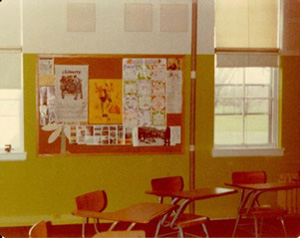
Above: This was the Spanish classroom at Divine Heart Seminary in Donaldson, Indiana, in the 1970s. This is one of the many schools where Señor Enrico Mordini taught. As an aside, Señor Mordini had a good sense of humor and got along well with the students. Once my classmates talked me into hiding in the fire escape, which was a giant slide in a huge metal tube on the right in the picture but out of view, and Señor Mordini humored us by looking for me wherever my classmates suggested: under his desk, under the student desks, behind the bulletin board, etc. 🙂

DDR

Speaking Spanish at work


I love fruit!

When I was about sixteen, my friend Reinaldo stopped by my house early one summer morning after the school year had ended. Of course, I was sleeping because I was relaxing from another demanding year at school. He told me that he had found me a job at a fruit stand. I was surprised because I had never told him that I was looking for a job.

Rey worked on a fruit truck that drove through the neighborhood and sold fruits and vegetables curbside. As a sixteen-year-old young man, I was impressed by his well-paying job and how he was so proud of it, especially since Rey was only fifteen. Anyway, when they were buying their fruits and vegetables at the market before they started the day, the owner of a fruit stand asked Rey if he had any friends who spoke Spanish and English. The fruit stand was trying to attract Mexican customers since so many lived in the neighborhood. Rey immediately thought of me. Well, I liked the idea of working so I could have some money to spend during the summer.

Well, when I went to the fruit stand, the manager told me that the owner was on vacation. I would have to work three days a week: Saturdays and Sundays, and another day during the week as needed. My duties included unloading produce from delivery trucks and waiting on customers. If the customer were a Mexican, I would have to wait on them in Spanish. I don’t remember how much I earned, but it seemed like a lot of money to me at the time. The owner was supposed to give me a raise when he returned from vacation, the manager told me. I worked there all summer and never once saw the owner.

Well, at first there weren’t that many Mexican customers, but the manager would call me to wait on anyone who looked Mexican. He decided who was or wasn’t Mexican just by their appearance. He was judging people based only on their appearance. And I, as a Mexican, wasn’t always so sure if they were Mexican or not. This kind of bothered me until I realized that he was always right. Now that I am older and wiser, I realize that he was exercising good business sense.

By the end of the summer, many Mexicans were shopping at the fruit stand. My friend Rey would stop by occasionally when they ran out of some product on the truck, and they would buy it at cost from the fruit stand. He was so proud that he had found me such a fantastic job. And I was so thankful to Rey for thinking of me for this job!

What did I learn from this experience? I still haven’t quite figured it out yet. But I’m sure that I learned something.

DDR

Social activism


Ph.D. 2005

Social activism is more than just signing petitions, campaigning for the right candidate, or demonstrating in public against a social injustice. I may not campaign for the right candidate or demonstrate against a social injustice by marching on the streets, but I am trying to better the world in my own way, the best I can.

I believe that today’s youth need role models. When I was growing up, I had plenty of role models through school, my friends, and their families. However, none of them were Mexican. At our grade school, the nuns always talked about what it would be like when we went to college–not IF we went to college, but rather, when we went to college. I really wanted to go to college because of that positive influence.

Unfortunately, my mother was disappointed because I wanted to go to college. By the time I was in high school, she was divorced with six children, and she had hoped I would work full-time to help her financially. I wanted to go to college so I wouldn’t have to work in a factory as she did. “Why do you want to go to college?” she asked me. “So I don’t have to work in a factory,” I said.

She didn’t know what to say next. Finally, she said, “Mexicans don’t go to college!” “Yes, they do,” I said. “Well, show me one,” she said. I thought about all the Mexicans in the neighborhood that I knew or knew of, but not one was a college graduate, or even a college student.

Had there been at least one Mexican college student in the neighborhood, I might have persuaded my mother to let me go to college. But I lived in the Back of the Yards neighborhood that has always been more of a port of entry for immigrants who eventually moved on; once they established themselves in this country, they moved out of the neighborhood to someplace better, anyplace else. So Mexicans did go to college, but by then they had moved out of our neighborhood.

Now, I want to let everyone know that I am a college graduate. I feel that I am a positive influence on struggling students of all backgrounds, but especially Hispanic students. A few have told me so. I have had adults of Hispanic and descent congratulate me for my academic achievements. They tell me, “Show them that we’re not all a bunch of dummies!” And this is how I plan to be socially active. This is my way of making the world a better place.

DDR

Life in Mexico


Mexico D.F.

Once when I was I boy, I visited Mexico, and I realized that I wasn’t Mexican. I was American! All my Mexican cousins told me so. I didn’t speak Spanish as well as them. My Spanish vocabulary was lacking compared to them. I always had to stop to think in order put my thoughts into Spanish. Even though I spoke Spanish with my family and friends in Chicago, I had lost what little Spanish I had, and I never improved my Spanish vocabulary by constantly speaking Spanish with Mexicans from Mexico. Well, some of the children made fun of how I spoke Spanish and called me gringo.

Well, one day, I noticed that my aunt had various copies of Life Magazine in her house. I immediately recognized the Life logo, white letters in a red block. I was so excited because now I would be able to read something in English! But upon picking up the magazine and flipping through the pages, I realized that the magazine was published in Spanish. One of my cousins asked me what I was reading, and I told him, “Life,” but I pronounced “Life” in English. He asked me to repeat it, and when I did, he said that I didn’t know Spanish because I didn’t call the magazine, “Li-fe,” pronounced in Spanish as two syllables. I explained that “Life” is an English word and so I pronounced it in proper English as a one-syllable word, with a silent e. Of course, he didn’t believe me. I was still el gringo who couldn’t speak Spanish. Not only that! I also couldn’t speak English! He called my other cousins over and told them about how I had my own peculiar way of pronouncing “Li-fe.” Well, after that, they constantly quizzed me about the pronunciation of “Li-fe.” Remember, “Life” in Mexico is “LI-FE” with two syllables!!

DDR