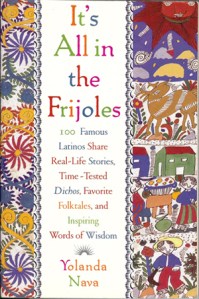
It’s all in the frijoles


This book makes a great gift!

What’s a Mexican meal without beans? I remember having beans with almost every meal, including breakfast. A meal that usually consisted of beans, rice, and tortillas, provided all the necessary proteins for a healthy diet. And so, meat wasn’t always necessary. Most Mexicans eat healthy diets until they come to America and start eating fast food. Mexicans must never forget to eat their beans, rice, and tortillas. When I say beans, I really mean frijoles. They were always frijoles to me. Even when I speak English, occasionally slip and I accidentally say frijoles instead of beans.

In Chicago’s Millenium Park, we have a sculpture by Anish Kapoor called Cloud Gate. But somehow, someway everyone started calling it the Bean. Everyone except me. To me, it’s ¡El Frijol! It’s a giant frijol to me. All the sculpture needs are the accompanying rice and tortillas. But I’m not the only one who associates Cloud Gate with something Mexican. In fact, in one of our downtown bus shelters, I saw a poster of El Frijol over the bottom half of the Aztec calendar forming a symmetrical circle. The two figures complemented each other.

Anyway, I read this book called, It’s All in the Frijoles: 100 Famous Latinos Share Real-Life Stories, Time-Tested Dichos, Favorite Folktales, and Inspiring Words of Wisdom by Yolanda Nava. I must admit that the book has a very impressive, all-encompassing title, and at first, I felt too intimidated to read it. So, I bought it as a birthday present for my father for his eightieth birthday. After he opened his presents at his party, a few people started leafing through the book. My sister thought the book was interesting after reading some of the dichos (sayings); at least she didn’t judge the book by its cover alone, which is very pretty.

So, I bought myself a copy of the book and piled it on my stack of “to read” books. When I finally read it, I suffered from an identity crisis. I wasn’t like anyone of those Latinos in the book. Whenever I’d read about a person of Mexican descent, I’d think, okay, I’ll have something in common with this Mexican. But no! When I compare her life stories with mine, I question whether or not I’m actually Mexican!
DDR

Men don’t cry!


Evanston, Illinois

Even as a young boy, I was always taught that men don’t cry. I never really saw the men in our family cry, except at funerals. I only saw my father cry when his mother died, his father died, his younger brother died in Viet Nam, and when my mother died. No one criticized the men for crying then. And the men never cried tears of joy.   

But when I was little, I was always reminded not to cry whenever I fell, I didn’t get my way, or someone hit me–even when my mother hit me with the belt. Either my mother or my abuelita would constantly say, “Los hombres no lloran” [Men don’t cry!]

Sometimes when I cried, my mother would hit me and say, “¡Para que tengas algo para llorar!” [So you have something to cry about!] Once when I was about nine, I got beat up by one of the boys on the block and I came home crying. When my mother saw me, she asked me why I was crying. I told her what had happened, and she started hitting me. She made go back out to beat up the boy who had beat me up. Well, I went back to the boy’s house, and I beat him up–and I beat him up good! He felt all the pent-up anger that I had built up inside of me from the previous two beatings–the boy’s and my mother’s. But I finally understood that men don’t cry.   

So, I learned to control my emotions. I didn’t cry when my paternal grandmother died; I was too young to understand. I didn’t cry when my paternal grandfather died; he died when he was 68 and he had fathered 18 children, so it wasn’t exactly a tragic death.

However, I did cry when my uncle Joseph Rodríguez died in Viet Nam; I cried because he was only 22. And I thought that I, too, would die in Viet Nam.

When my mother died, we had a lot of unresolved issues between us. I think the main reason I didn’t cry when she died was because I constantly heard her saying, “¡Los hombres no lloran!”   

DDR

Hoy


Brighton Park, Chicago, Illinois

In Chicago, we have newspaper Hoy that is published in Spanish by the Chicago Tribune. I enjoy reading the news in Spanish because it provides a different perspective. Sometimes Hoy has articles that wouldn’t appear in other local newspapers because they deal with local Hispanic interests. I also subscribed to the Chicago Tribune, but I read Hoy first. Some articles appear in both the Tribune and Hoy. When they do, the articles seem to have been written in English first and then translated into Spanish for Hoy; they contain the same information in the same order. There are many more typos in Hoy than in the Tribune, but I still enjoy reading Hoy.

I have Hoy delivered to my house. Would you believe that this subscription is free? I believe that if you live in the delivery area for the Chicago Tribune, you may subscribe. Here is their telephone number in case you’d like to subscribe: 312.527.8467.

Anyway, I also have the Chicago Tribune delivered to my house. When I ordered Hoy, I started having problems with my newspaper delivery. I’m not sure what happened, maybe the delivery person didn’t think I could read both English and Spanish. I would either get the Tribune or Hoy, but not both. I really couldn’t complain about not getting Hoy since I didn’t pay for the subscription. However, I was paying for the Tribune subscription, and I wanted to read the news. I called to complain and now I get both newspapers regularly. A couple of weeks ago, instead of receiving the Tribune and Hoy, I received the Korean Daily! I can’t read Korean! I wonder how the Korean Daily subscriber reacted when receiving Hoy!

DDR

Teatro Villa


1821 S. Loomis Avenue, Chicago, IL 60608

After my parents’ divorce, I spent a lot of time with my father. Sometimes he would pick me up just so I could accompany him to run his errands and translate for him. He spoke broken English and he was painfully self-conscious about it. So, I would be his translator, although at that time my English wasn’t much better than his. When we spoke to each other, I spoke English and he spoke Spanish; when I first started attending school, he insisted that I speak English so he could learn to speak English, too.

In order to do all his errands, he would find parking somewhere near 18th Street, Loomis Avenue, and Blue Island Street. That meant we would either pay his telephone bill, go grocery shopping, eat at a Mexican restaurant, or see a Mexican movie in Spanish at Teatro Villa. If he managed to find a strategically located parking spot, we could walk to all these places without moving the car. Sometimes he would drive around for fifteen minutes looking for this ideal parking spot. Now that I think of it, we passed up some good parking spaces that were only a block away and I would tell my father, “Just park already!” But he always insisted on finding the closest parking space.

After my father was done with all his errands and we ate at a Mexican restaurant, we would buy are tickets to see a movie at Teatro Villa. All the movies and previews were in Spanish. My father loved coming to this theater because it reminded him of Mexico. We would enter the theater regardless of when the movie started. We usually sat down in the middle of the movie and didn’t get to see the beginning until after seeing the entire second movie and the previews. I had fun trying to figure out what had happened prior to the scenes we were watching. Once the beginning of movie came on again, I liked to see if the movie had foreshadowed the ending. So, my father’s disorganized habits had actually helped me to become a better writer.

There was one movie that we saw that I never quite understood even though we saw it twice; when we returned to Teatro Villa the next week it was showing again, but we decided to see it again. I don’t remember the title, but it took place in downtown Mexico City sometime in the 1960s. This movie was also in Spanish. Anyway, people are being mysteriously murdered one by one. No one can figure out who is murdering them. I forget all the details, but eventually we discover that there is a secret society that still practices human sacrifice following the Aztec rituals. These are businessmen who enter through a hidden door in their office and descend to an underground cave where there is an Aztec pyramid with a sacrificial altar. The murder mystery is then solved, and the murderers are arrested. But the movie did emphasize the importance of Aztec culture in Mexico even to this day.

We saw many movies together over the years at Teatro Villa. I remember seeing a lot of comedies, but my favorites were with Cantinflas, also known as Mario Moreno. He always made me laugh. Cantinflas was a poor Mexican who never caught a lucky break. He was so poor that he always wore raggedy clothes and survived day to day by his natural wherewithal. His poverty was only surpassed by his ineptitude. No matter what job he worked, he performed it incompetently, even disastrously. When the boss asked him if he had done his work, Cantinflas would begin a longwinded explanation that would distract the listener, but he never fully explained if he actually did the job. His boss would finally ask, “Did you do your job?” And Cantinflas would say, “Pues, allí está el detalle” and explain how didn’t do it. He was always incompetent, but extremely lovable. I always laughed at Cantinflas because I could relate to him. I think it was because he reminded me of my father in some ways. In fact, after leaving a Cantinflas movie, my father would start quoting Cantinflas. Sometimes my father talked like Cantinflas even when he wasn’t imitating Cantinflas. My father told me that Cantinflas got his name from the saying, “Cuando entras la cantina te inflas.” Meaning that when you go into the bar, you get full of hot air. My father also told me “Cantinflas” was a combination of the verbs cantar and inflar combined. Cantinflas was the master of talking and talking without really saying anything.

DDR

Domingos


For our family, Sunday was a very special day that began at sunrise and didn’t end until we returned home well after sunset. My parents would get up long before my brothers and me in order to prepare for our big day. My father usually prepared his car by making some last-minute adjustments under the hood and then washing the car in front of the house. My mother would–actually, I’m not sure what my mother did; whenever I woke up early enough to help her, my mother would be very secretive and then tell me to go help my father with the car. Once the car was packed, we would all dress up in our Sunday clothes, which were the very best clothes we owned, and go to Sunday mass at the Mexican church in the neighborhood because the priest said the mass in Spanish. This was a welcome change from the Latin mass at the Lithuanian church where I was really supposed to attend mass with my classmates from the parish grammar school.

After mass, we would all pile into the car, sans seatbelts or child safety seats, and head to the beach, Lincoln Park Zoo, Shedd Aquarium, the Field Museum, or the Museum of Science and Industry to spend the day there. We usually went somewhere that was free. On the way there, we would stop at el supermercado to buy our food for the picnic. I always thought my mother was packing a picnic basket at home until we went to el supermercado. Anyway, we would buy bolillos, carnitas, chicharrón, atole, and anything else that didn’t require cooking. I guarantee you that nothing tastes better than a bolillo stuffed with carnitas on a beautiful, sunny Sunday at the beach on the Chicago lakefront after going to mass in Spanish! I really loved going to the Museum of Science and Industry and then swimming at the beach afterwards.

Of course, we varied our habits occasionally. Sometimes we would meet friends of the family at the church and ask them to come along with us, or if they had better plans, we would go with them. Once we had a caravan of four cars. This was fun because we would have more children playing together.

Sometimes after mass, we would visit other family members without notice. Sometimes we would go to several houses before we found someone who was actually home! Nothing was ever really planned. Perhaps, that’s why I still like to take spontaneous, unplanned vacations with my sons to this day. When it was time to go home, we would always say good-bye for at least an hour. Well, everyone would say good-bye right away and set a date for the next get-together, but then someone would remember what he or she had been wanting to tell everyone for the longest time. And that, in turn, would remind someone of somebody else who was no longer living in the neighborhood, and so on … But we always had fun!

Well, I don’t want to drag out this good-bye too long. You get the idea. Besides, it’s Sunday and I’m on the way out the door! ¡Adiós!

DDR