I had my usual morning cup of coffee and then went out for my morning run. I really work at being healthy. I admit that I still have some vices, but I try to counterbalance my bad habits with good ones.
It was a bright sunny morning in the 70s with no humidity. I felt great running in Beverly now that the cicadas have disappeared for another 17 years. I was euphoric. Some runs just feel great. Like today’s. I wondered why I was even running today in the first place. After considerable thought, I remembered the one defining moment that changed my attitude toward exercise.
For visitation, my father would often take us to the beach. We would take swimwear, bikes, and food, and spend the entire day there. I really enjoyed those trips to the beach. One day, I was about fifteen at the time, we saw an elderly man running on the bike path—not jogging, RUNNING! He was slender, but muscular; he had a full head of hair, but it was completely gray. I’m not sure how old he was, but back then, in Chicago, men that age did not RUN! I’m sure what he did next was exclusively for our amazement: he stopped near a steel-mesh wastebasket, he grabbed the rim of the wastebasket, did a handstand, and began doing handstand pushups! My brothers and I were utterly amazed. I told myself that I would someday be like this man.
Well, I have been running all these years to stay healthy. I’ve genuinely enjoyed running because the exercise keeps me healthy physically and mentally. However, I was never able to do even one handstand pushup!
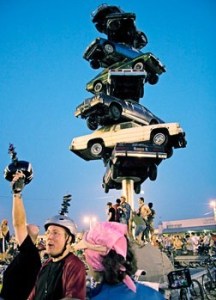
Chicagoland is about to lose another cultural icon. I’m talking about the eight-car pileup in Berwyn at Cermak and Harlem, officially titled, “Spindle,” but also known as “Car-kabob.” This forty-foot spindle pierces eight cars to make its artistic statement, regardless of how kitsch many consider this sculpture. A little red Beetle Bug crowns this masterpiece like a cherry on a sundae. Immediately below the Beetle is my favorite car, but it’s only my favorite because it bears the license plate “Dave.”
I always loved driving by “Spindle” because it was so unique to Chicagoland. It is “art” and yet it isn’t. I was so happy to recognize it when I saw the movie Wayne’s World for the first time; the cigar Indian almost moves me as much, though. I once watched Wayne’s World just to see the “Spindle” again.
Hopefully, we can all gather to save the “Spindle.” Walgreens, another Chicagoland icon, plans to build a store on the site, so the “Spindle” will have to be relocated and refurbished or be lost forever. Surely, there must be plenty of “Spindle” lovers who will help save it. We must let the Berwyn municipal officials know! Save the “Spindle”!
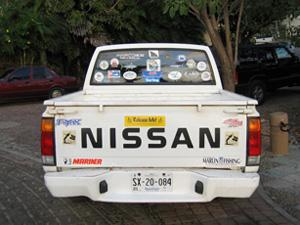
I enjoy reading so much that I’m glad someone invented bumper stickers! Now I can also read while I drive. The other day, I saw this bumper sticker as I drove: “Bumper to Bumper / Butt to Butt / Get Off My Ass / You Crazy Nut.” Well, that was a very lame bumper sticker as far as bumper stickers go. I thought back to the glory days, the actual Renaissance of bumper stickers. I remember reading some excellent bumper stickers long ago, in the Golden Age of public expression.
Yes, like many American cultural icons, bumper stickers were born about the same time as t-shirts with messages, way back in the 1960s when everyone seemed to have something important to say. Once, long ago, t-shirts were underwear, something that men wore under their dress shirts with a collar. And there were no bumper stickers then; bumpers were still bare and naked. Their sole purpose was to protect the car and its occupants in case of a collision. In the 1950s, juvenile delinquents, JDs, began wearing white t-shirts as outerwear and car bumpers got bigger and brighter chrome, but alas, neither took advantage of all the possible attention that was showered upon them in the 1960s. Then, someone viewed the white t-shirt as a blank canvas intended for artistic expression. And, Voila! The message t-shirt was born, and riding on its shirttails, was the bumper sticker.
Some of the messages were exclusive to their medium, but most messages expressed themselves equally as well on a t-shirt or a bumper sticker: “If I told you that you had a beautiful body / would you hold it against me?” However, I prefer bumper stickers. T-shirts have long ago reached their saturation point and we’re now seeing the reemergence of plain white T-shirts. I prefer the bumper stickers because I love to read, and they allow me to read while I drive. I wax nostalgic as I recall some of my favorite bumper stickers! I can still see them, like my family and friends gathered round the holiday dinner table! Let me recall a few for you.
I remember there were political messages: “No Nukes,” “Save the Whales.” And there was a religious message: “Jesus Saves.” And then some genius, in a stroke of absolute brilliance, penned this magnificent treasure: “Nuke the Whales for Jesus”! I was amazed that this author didn’t win the Nobel Prize for literature.
When the Born-Again Christians bragged, “I Found It,” National Lampoon offered the rebuttal: “I Lost It!” For a while many station wagons and minivans boasted, “My child is an honor student at …” Suddenly, there were some bumper stickers that read, “Your Kid’s an Honor Student / But You’re a Moron” and “My Kid Beat Up Your Honor Student.” To “If You Can Read This / You’re Too Close,” someone replied, “If You Can Read This / Thank a Teacher.” And for the aggressive tailgater, “Sorry for driving too close in front of you.”
Then there those bumper stickers that expressed a variety of feelings: “Beauty Is In The Eye Of The Beer Holder.” “Insanity Is Hereditary / You Get It From Your Kids.” “Ex-Husband In Trunk.” “Don’t Hit Me / My Lawyer’s In Jail.” “How’s My Driving? / 1-800- EAT SHIT.” “Gas, Grass, Or Ass / No One Rides For Free.” “If This Van’s A Rocking / Don’t Come A Knocking.” I saw an old clunker sporting this bumper sticker: “My Other Car Is A Rolls Royce.” Then I once saw a Roll Royce with this one: “My Other Car Is A Lear Jet.”
As much as I love reading bumper stickers, I have only ever had one bumper sticker on all my cars: “USMC.”
In the movie Napoleon Dynamite, we see Mexicans in, of all places, the state of Idaho! As a bonus, you may also listen to the movie dubbed in Spanish. The first time I saw the movie, I thought, “But there are no Mexicans in Idaho!” Then I met a Mexican name Irene from Idaho. So, I guess there really are Mexicans in Idaho. In the movie, Pedro the Mexican is viewed as a foreigner by the high school principal who tells Pedro on his first day of school, “You do understand English. This isn’t really that complex.” And Pedro just stares at the principal, so the principal asks Napoleon Dynamite to show Pedro where his locker is. Pedro is the only boy at the high school with a mustache, which impresses Napoleon.
Napoleon and Pedro become friends because they’re both outsiders in this cliquish world of jocks and cheerleaders. They get along so well because they complement each other very well. Napoleon accepts Pedro for what he is, and Pedro listens to Napoleon’s stories and lies without questioning them. Pedro speaks English, but sometimes it’s not perfect. For example, Pedro plans to ask the cheerleader Summer Wheatley to the dance. When Napoleon asks how Pedro will get Summer to go to the dance with him, Pedro says, “I’ll build her a cake or something,” with a heavy Mexican accent. When Summer says no, Pedro asks Deb, Napoleon’s prospective date, to go to the dance. So that leaves Napoleon without a date. Pedro offers advice and Napoleon follows it. Napoleon is on his home turf in that high school, but Pedro exudes more self-confidence than Napoleon throughout the movie.
Pedro even has the courage to run for school president. Napoleon uses his skills to help Pedro for the school election. Later when Pedro runs for school president, Napoleon tells a kid who is being bullied, “Pedro offers you, his protection.” When one of the school bullies tries to take that kid’s bike, Pedro’s cousins, listed as Cholo #1 and Cholo #2 in the final movie credits, show up in their low rider that says, “Vote 4 Pedro” on the door, and they gesture to the bully to stop. The bully runs away without the bike. Of course, Pedro’s cousins look like the stereotypical gangbangers from East L.A. who would beat up the bully if necessary. The two cholos merely shake their head and the bully gets scared and runs away. The movie purposely plays into these Mexican stereotypes. By the way these cousins are eventually cast in the series Breaking Bad.
When Pedro makes a piñata of Summer Wheatly and the students break it, the principal calls Pedro into his office “Look, Pedro. I don’t know how you people do things down in Juarez … Smashing in the face of a piñata that resembles Summer Wheatly is a disgrace to you, and me, and the entire Gem State.” But Pedro doesn’t understand why not since they do it in Mexico all the time. Pedro and his family represent the foreign element in the otherwise homogenized American society of Idaho. Pedro really stands out at the high school as being an outsider because he hasn’t assimilated yet.
In the end, there is a school assembly for the presidential candidates Summer Wheatly and Pedro Sánchez to address the school. In Summer’s campaign speech, she promises two new pop machines in the cafeteria, new cheerleader uniforms, among other things, and then asks, “Who wants to eat chimney-changas next year? Not me! With me, it would summer all year long. Vote for Summer.” Of course, Summer, too, uses the Mexican stereotype for the purpose of fear mongering. For his speech, Pedro promises, “I think it would be good to have some holy Santos brought to the high school to guard the hallway and to bring us good luck. El Santo Niño de Atoche is a good one. … If you vote for me, all of your wildest dreams will come true.” Pedro doesn’t change his speech despite the fact that Summer Wheatly made Pedro look like an undesirable foreigner.
In the end, Pedro wins the election and becomes school president with the help of Napoleon’s skit. Well, the students accept Pedro and Napoleon for being themselves. Pedro’s family celebrates by having a picnic for Pedro. Of course, there’s a cake with red, white, and green stripes that says, “Presidente Pedro! ¡Felicidades!”
This movie illustrates how people have accepted Mexicans without realizing it. Until the immigrant marches last year, Mexicans were invisible. No one saw them as individuals doing landscaping, housekeeping, working in factories, among other jobs. And they accepted Mexicans exactly for who they were. Whether America admits it or not, a lot of people are voting for Pedro.
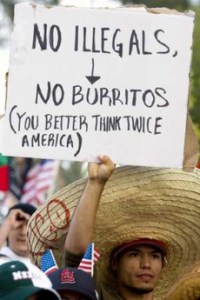
America, you better think twice. ¡No Mexicans, no burritos! Next time you’re about to bite into that burrito, will you ask yourself, “Is this burrito here legally?” Of course not! You crave that tasty burrito, and you’ll enjoy every bite of it.
Not many people really think about citizenship in their day-to-day existence, unless of course, they’re not U.S. citizens. No one really thought about how many Mexicans were in the Midwest until the immigration marches last year. Since then, everyone seems obsessed by a person’s state of citizenship, whether or not they’re here legally. It’s an immigration version of the House Un-American Committee, or the Don’t Ask, Don’t Tell policy in the military. Now whenever I read about Mexicans in the news, there’s no doubt if the subject is a citizen because the author will state their citizenship status. Or, if not a citizen, we read something like, “does want to give last name because he/she is not a citizen.”
On the July 4, I read “Squeegee economics” in the Chicago Tribune about Chicago skyscraper window washers from Mexico. For example, Salvador Mariscal of García de la Cadena, México, cleans the windows of the John Hancock Center and he’s a legal immigrant. Juan Ortiz, who worked illegally in Chicago for three years, is mentioned by name because he is now living in México again. Would you believe the Tribune reported that there are illegal immigrants washing skyscraper windows in Chicago?
Maybe we should work on the immigration reform bill a little harder. If we deport all the illegal Mexicans, we won’t have burritos and we’ll have dirty windows to boot.



 Chicago USA