Combination locks


Security against terrorists

As a law-abiding citizen and a patriotic American, I would like to participate in our fight against terrorism. I agree that we must stop the terrorists at the border. 

I have crossed the border a few times, so I have an idea that may help. Sometimes the customs agents ask you questions to see if you’re really an American citizen. I don’t think they care how you answer the questions, but rather, they’re just checking to see if you speak English. I heard a story of an American family who was trying reenter the United States, but all their luggage, credit cards, and passports were stolen from their hotel room. They reported the theft and then flew back home without passports. Customs refused to let them through without passports or some form of identification. The customs agent asked them a lot of questions. Finally, the mother lost it and shouted, “We’re Americans! We only speak English!” Well, that was enough for the agent to wave everyone through! 

We have a cabinet in our UIC Spanish department where the exams are stored so all the instructors have access to them. The cabinet had a combination lock so we wouldn’t need to make thirty plus keys. Well, even with the combination, not everyone could open the cabinet. On occasion, I had to help other instructors open the combination lock. Then, I noticed a pattern. Only instructors who were foreign-born had trouble opening the lock. 

Only Americans are familiar with combination locks. Combination locks are an American rite of passage. I was indoctrinated to the use of padlocks in high school. Combination locks were perfect for adolescents who lose or forget their key. Plus, the school authorities could open any combination lock in the school by looking up the combination or with a little key that fits into the back of the lock. Everyone knew how to open a combination lock, or they would learn quickly enough out of necessity. Turn the dial twice to the right until you reach the first number. Then turn the dial to the left, passing the second number once. Then to the right to the last number. It was that easy! After a while, I would forget the actual combination numbers. I would spin the dial absent-mindedly and the lock would mysteriously open. The locks created the illusion that your property was safe. All those combination locks did was keep the honest people honest. 

So back to my fight against terrorism. One of the tests to test for citizenship and reentry to the U.S., in addition to all the previous ones that have been proven to be effective, would be to hand a combination lock to the person requesting to enter the U.S. Tell them the combination: 27 – 32 – 15. If they can’t open the lock, well, well, well! They will require more scrutiny! This will not pick out every terrorist, but it’s a step in the right direction. Don’t be surprised if terrorist camps begin offering training workshops on how to operate combination locks to circumvent the new security measures. But I’m just trying to do my part. 

DDR

Passport issues


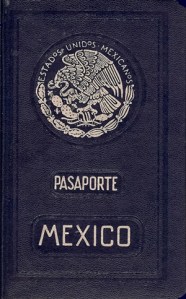
My Mexican Passport

Well, since I always talk about my name, let me get back to the name of David Rodríguez. Well, actually, David Diego Rodríguez. I bring it up again because I plan on going to Mexico in July with my sons. And every American citizen needs a U.S. Passport to return to the U.S.

So, I had to apply for passports for all three of my sons who are natural citizens by virtue of having been born in Chicago, Illinois. Two of the three passports were immediately processed by U.S. Department of State.

The one for my son with my name caused a delay. They needed more documentation for him. There are just too many David Rodríguezes. He’s only eighteen, so he doesn’t have a credit history, a driver license, or a credit card. They needed more proof to verify his identity. I wasn’t sure what they wanted or what other documentation I could provide. One of the enclosures listed in the letter was a Supplemental Identification List, which they had forgotten to enclose. I sent everything I could think of, including photocopies of his state ID, his school ID, his W-2 forms, federal tax return, state tax return, a prescription label with his name and address. I was extremely relieved when they accepted the enclosed documentation. I finally received his passport yesterday. We’re all set to go to Mexico now.

I remember when I went to Mexico in 1978, things were so much different. I had forgotten how to speak Spanish. I still understood it, but I never had to speak it much in Chicago. I stayed in Mexico for about a month and so I quickly learned to speak Spanish again.

However, when I returned to Chicago, I had trouble speaking English again. I flew back on Mexicana Airlines and when I was in Customs at O’Hare Airport the agent asked me for my proof of citizenship. All I had was my driver’s license and birth certificate. I gave them to him and then I worried that they wouldn’t let me go back to Chicago.

You see, my driver’s license didn’t have a picture of me. Back then, they were printed on thin cardboard and only described the driver as 5’8″, 128 Lbs., BRN Hair, BRN Eyes. My birth certificate didn’t have much information on it either and my last name was misspelled as, “Rodriquez” with a “q” instead of “g.” (My mother never thought the mistake was important enough to correct when she received my birth certificate in the mail soon after I was born.) The agent looked at my documents carefully and asked me if I had anything to declare. I understood him perfectly, but I couldn’t form the words in English. I thought for sure that the authorities would detain me because I couldn’t make myself speak my fluent south side English. But miraculously, he let me through. I could then understand how there were so many illegal immigrants from many countries in the U.S.

When I went to Mexico last December, it was a little more difficult to enter Mexico. I handed my passport to the agent, and he entered the information on a computer. He asked me some questions and when I answered them satisfactorily, he let me back into the U.S. Then about sixty miles into the U.S. there was another checkpoint where I had to present my passport again and answer some more questions. They asked me the questions to see if I really spoke English to prove I was a U.S. citizen. The agent spoke quickly and slurred his words together as if to test my knowledge of English. Either that or he was just bored of his job and just going through the motions. He asked me where I was from. When I said Chicago, he asked, “Born and raised there?” “No. I was born in Perth Amboy, New Jersey.” I suppose that if someone didn’t speak English well, they wouldn’t have been able to answer those questions, raising suspicions. I was glad that I didn’t have trouble speaking English this time.

DDR

Immigration, legal or otherwise


Do you really want to live without Mexican food?

America, you better think twice. ¡No Mexicans, no burritos! Next time you’re about to bite into that burrito, will you ask yourself, “Is this burrito here legally?” Of course not! You crave that tasty burrito, and you’ll enjoy every bite of it.

Not many people really think about citizenship in their day-to-day existence, unless of course, they’re not U.S. citizens. No one really thought about how many Mexicans were in the Midwest until the immigration marches last year. Since then, everyone seems obsessed by a person’s state of citizenship, whether or not they’re here legally. It’s an immigration version of the House Un-American Committee, or the Don’t Ask, Don’t Tell policy in the military. Now whenever I read about Mexicans in the news, there’s no doubt if the subject is a citizen because the author will state their citizenship status. Or, if not a citizen, we read something like, “does want to give last name because he/she is not a citizen.”

On the July 4, I read “Squeegee economics” in the Chicago Tribune about Chicago skyscraper window washers from Mexico. For example, Salvador Mariscal of García de la Cadena, México, cleans the windows of the John Hancock Center and he’s a legal immigrant. Juan Ortiz, who worked illegally in Chicago for three years, is mentioned by name because he is now living in México again. Would you believe the Tribune reported that there are illegal immigrants washing skyscraper windows in Chicago?

Maybe we should work on the immigration reform bill a little harder. If we deport all the illegal Mexicans, we won’t have burritos and we’ll have dirty windows to boot.

DDR