Bilingual


Chicago, Illinois, USA

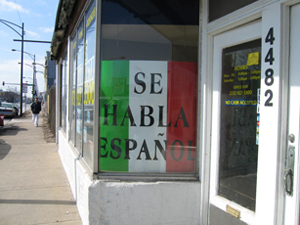
I was born in Perth Amboy, New Jersey, but my first language is Spanish. We moved to the Pilsen neighborhood in Chicago when I was about two years old. We only spoke Spanish at home. All our visitors spoke Spanish. As I recall, even my childhood playmates spoke Spanish. When we went to mass at our neighborhood church, the priest said mass in Spanish. I believe everyone around me always spoke Spanish until I started school. When I watched television, it was in English. Occasionally, I would go shopping with my parents where I heard languages other than Spanish. However, the only language I understood was Spanish.

Since I grew up in the neighborhood called the Back of the Yards, I heard many different foreign languages along with English. When I played outside with the other children, I never understood what they said if they spoke a language other than Spanish. Although I often heard English, I did not learn to speak any English until I entered Kindergarten. It was the sudden immersion method since I had never spoken more than a few words of English at a time. Suddenly, for hours at a time, I only heard English, and the teacher expected me to respond in English. We learned nursery rhymes and songs that used archaic English words. When I attempted to use some of the new English words that I learned from the nursery rhymes or songs outside of school, other children would laugh at me. For example, I was ridiculed when I called a female classmate a lassie. I learned “lassie” from the song, “Have you ever seen a lassie go this way and that way?”

I attended a Lithuanian Catholic grade school called Holy Cross Grade School in the Back of the Yards neighborhood. All of the priests and most of the nuns spoke Lithuanian and English. We were always conscious of the fact that our neighborhood was the setting for the Lithuanian family in the novel The Jungle by Upton Sinclair. During school hours, the nuns stressed the importance of learning English and we were not allowed to speak our native tongue whether it was Spanish, Polish, or Lithuanian. We had to master English if we were to function in a Catholic and American society.

What helped me learn English was the constant repetition of songs and prayers. Rote memorization was the norm. I improved my English vocabulary by writing down important words several times. This constant repetition helped me learn English. Every morning we went to church to attend mass in Latin before school. We prayed a “Hail Mary” before class in the morning. In the afternoon, we prayed the “Our Father” and the recited the “Pledge of Allegiance” before class. I often did not understand the lessons taught at school. When the teachers instructed the students to complete a task, I was usually the last one to comply because I didn’t understand the command in English and would belatedly obey it by watching what the other students did. Sometimes, my classmates made fun of me because I was slow to follow the instructions. Occasionally, the teacher would correct my English and students would make fun of me after class.

At home, my parents insisted that I speak English so that they could also learn English. The more English I spoke, the more Spanish I forgot. In the end, my parents realized how difficult it was to learn English, so they never really learned it well enough to become fluent. We ended up speaking these bilingual conversations where I spoke English to my parents and they spoke Spanish to me. Of course, certain terms were not translated from their original language. We often spoke in a mixture of English and Spanish: Spanglish. Once I knew how to speak English well enough to get by, I became the official family translator at age eight; I had to translate whenever we went out, and we needed directions or my parents had to conduct some sort of business. I was always self-conscious about the way in which I spoke English because of my Spanish accent.

When I was in the fourth grade, I felt embarrassed by the way I spoke English. I wanted to improve my fluency, so I read books to feel more comfortable with English. When I got my first library card, I spent a lot of time at the library reading books. I also borrowed a lot of books to read at home. I really loved the joke books because I learned the multiple meanings of many words. For example, “What did the ocean say to the beach? Nothing, it just waved.” These jokes and riddles helped realize that words had multiple meanings. This helped me to increase my English vocabulary while I also learned to enjoy the humor of the English language.

Unfortunately, I still had trouble comprehending the classroom lessons in the fourth grade. When we went to Mexico for two months during that school year, I had lost the little English fluency I had. In Mexico, I realized that I did not speak Spanish as effortlessly as my relatives in Mexico. When I played with my cousins, they made fun of my speaking that was part English, part Spanish. When I returned to Chicago, I realized that my classmates still made fun of my English. I did not speak either language very well. I also learned that I would fail the fourth grade because I missed two months of school due to our extended Mexican vacation. Since the teacher said that I failed in part because of my problems with English, I have always felt self-conscious about my English.

As I grew older, I wanted to be bilingual in English and Spanish and speak both languages fluently, like a native speaker. I often tried to read, write, and speak English and Spanish whenever possible. When I was in the Marine Corps, I studied English grammar books extensively. I read in Spanish whenever I came across something written in Spanish. However, it was not until I attended the University of Illinois Chicago that I felt that I really learned English and Spanish. To this day, I feel that I speak English with a Spanish accent and Spanish with an English accent.

caricature of author at end of post
DDR

Dave the Obscure


Books are knowledge

I love reading. Especially now that I’m older and have plenty of time to read. I even read candy wrappers lying on the floor.

In grade school, I enjoyed reading in the first and second grades since the sentences were usually two or three words long and the books were very short. Later, I loved reading when the class took turns reading aloud. I remember we read Washington Irving, Hans Christian Andersen, and Mak Twain. I can honestly say that I enjoyed the readings and still partially remember Ichabod Crane, the skaters on the frozen Dutch canals, and the celebrated jumping frog of Calaveras County.

Other than comic books, I didn’t do much reading outside of class. But I did buy books from the Scholastic Book Club through school. The only book I remember buying was Far from the Madding Crowd by Thomas Hardy in the seventh grade. I liked the book cover artwork and the title intrigued me. However, I didn’t actually read it then, but I kept it along with my other prized possessions. Although I did willingly read two books that I borrowed via U.S. mail from Divine Heart Seminary when I was in the eighth grade: Fighting Father Duffy and Father Damien. This was the seminary’s recruiting tool. Father Duffy was a World War II chaplain and Father Damien was a missionary who worked with lepers.

In high school, I never read any of the assigned readings. I was an unhappy teenage student because I was not allowed to attend the high school of my choice. I refused to read anything for homework. My freshman year of high school, Mrs. Shaefer kept after class to tell me that I had to start reading the class texts. I found the class discussions interesting, but not interesting enough to motivate me to read Hemingway, Fitzgerald, or Steinbeck.

I remember my junior year we were assigned to read Macbeth for homework. Of course, I refused to read it. However, the teacher held captivating discussions about the play and William Shakespeare. I was almost tempted to read Macbeth. Then, she announced that we were going on a field trip to see the movie version of Macbeth. Luckily, I was able to follow the storyline thanks to the class discussions. I really enjoyed the movie. I still think of it from time to time. In fact, I have read and re-read Macbeth several times since high school.

So, I didn’t read any assignments in high school, not even Macbeth. I came oh so close to reading Macbeth on my own. It would be years before I finally read it. I didn’t do much homework once I turned eighteen and started working at Derby Foods making Peter Pan peanut butter. I eventually dropped out of high school because I couldn’t manage working the midnight shift and attending classes right after work.

Plus, my high school counselor would not allow me to take the ACT or SAT exams required to apply to universities. He told me I wasn’t smart enough and i would only be wasting my time. Looking back now, I realize that this was a blatant case of racial discrimination. The counselor asked me how I planned to pay for college tuition. I didn’t know. When I told my mother that I wanted to go to college, but that the counselor wouldn’t let me take the college exams, she asked me how I planned to pay for tuition. I didn’t know. My mother also told me, “You already have a job! You don’t need to go to college.” So, I continued working my factory job. I was in the class of 1974, and the class of 1975, and the class of 1976. And I eventually dropped out.

The next year, my friends Jim, Ted, and Nick needed a ride to check out some potential universities they could attend. The had made appointments at Bradley University, University of Illinois Champaign-Urbana, and the University of Chicago. Since I was still working a factory job, I had a new car and was able to take them to several universities in Illinois. I worked the midnight shift then, I was free in the day time to take them. I got by on very little sleep back then.

On the way there, they wondered how they would pay for college tuition. I wondered, too. Well, each university counselor told them not to worry about tuition. If they were accepted, the money would come from somewhere in the form of student loans, scholarships, or grants. No one ever told me about student loans, scholarships, or grants. Why did they provide my friends with this useful information and not me? Well, I forgot to mention that they were white and I was Mexican.

So, I didn’t go to college and continued working in the peanut butter factory. I always felt embarrassed about being a high school dropout. Therefore, I decided to educate myself. By reading. Reading all the books I was supposed to read in high school. So, I read Steinbeck, Hemingway, and many other assigned readings that were long overdue. Eventually, I came across my old copy of Far from the Madding Crowd. It felt rather thick and intimidating, but I was determined to educate myself by reading. I continued reading over the years. If I liked an author, I would attempt to read all their books. This included: Ernest Hemingway, John Steinbeck, Kurt Vonnegut, Herman Hesse, J.D. Salinger, and yes, also Thomas Hardy. Lest we forget, Thomas Hardy coined the phrase, “Lest we forget.”

I decided to educate myself by reading. In the Marines, I bought the Great Books from Encyclopedia Britannica and read them all. I read voraciously. Eventually, I came full circle to Thomas Hardy. I planned to read all his books. They were all very moving, uplifting, and depressing all at once. However, the one book that really seemed to be about me was Jude the Obscure! The protagonist, due to his social circumstances, never obtained a formal university education. Just like me! So, he decided to educate himself by reading and studying books on his own. Just like me!

Spoiler alert! Jude Fawley does educate himself, but he never succeeds without a formal university degree. I found myself in a similar situation when I applied for the position of running coach at a university. I had all the necessary qualifications to coach, but without a university degree, I would not make a good role model for the students. And I was a published writer at the time. All for naught!

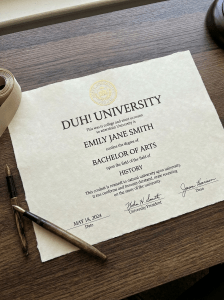
Well, I was finally able to get a formal university education with several degrees all they up to and including my Ph.D. The tragedy of Jude Fawley inspired me to go back to school. Every time I read Jude the Obscure, I recall my factory days reading books while I was on break. I realize now that I was also the victim of the social class barriers. Just like Jude Fawley.

caricature of author end of post
DDR